
A Class System With Missiles
There is an old American myth that still hangs around public life like patriotic wallpaper.
It says the nation goes to war carefully. Deliberately. Constitutionally. That force is used only after sober debate, legitimate authorization, and some recognizable form of shared sacrifice.
That story is comforting. It is also getting harder to defend.
What we are watching now is not simply bad judgment, partisan drift, or another round of foreign policy confusion. What we are watching is a deeper structural fact:
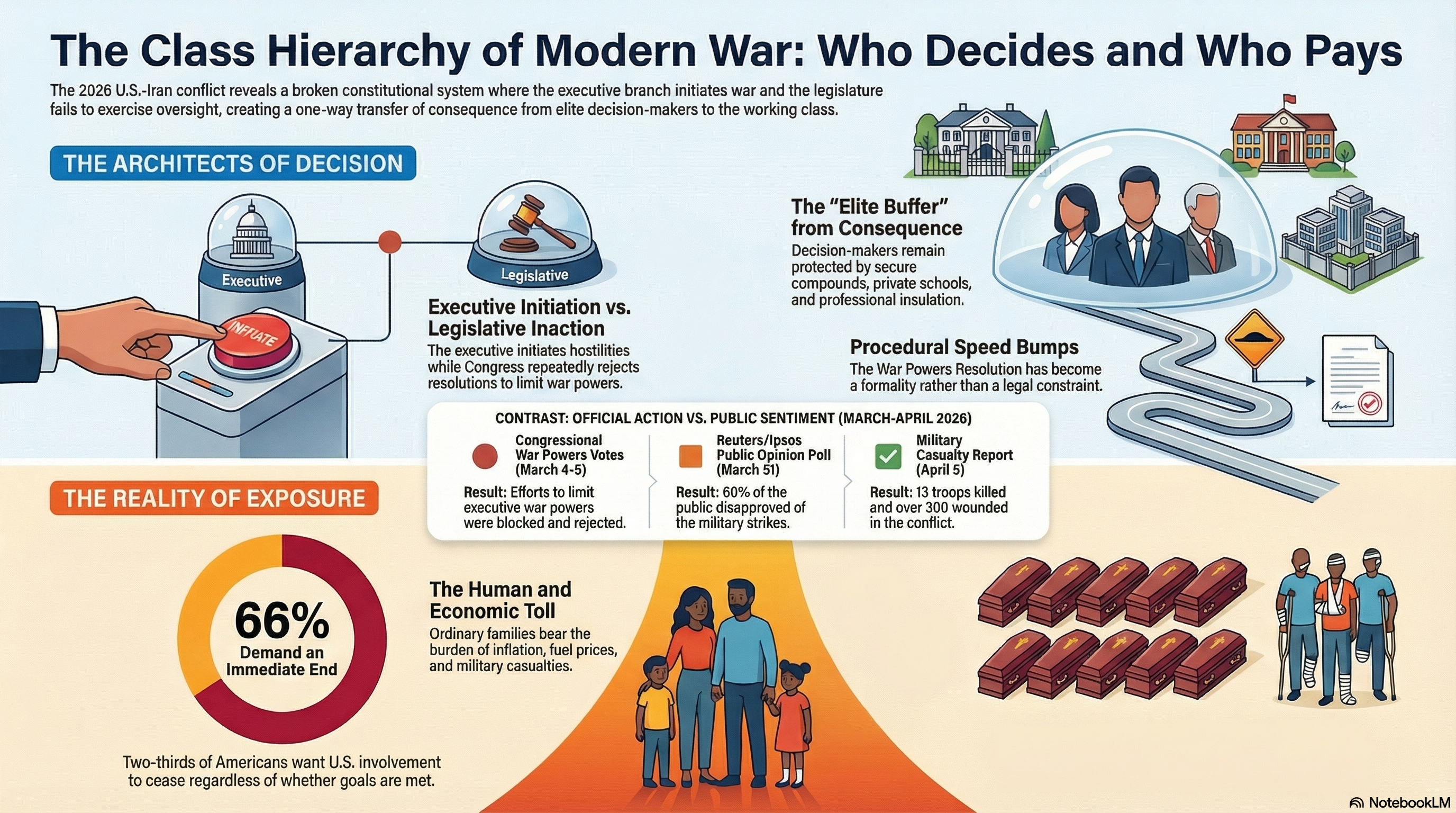
war in modern America increasingly functions like a class system with missiles.
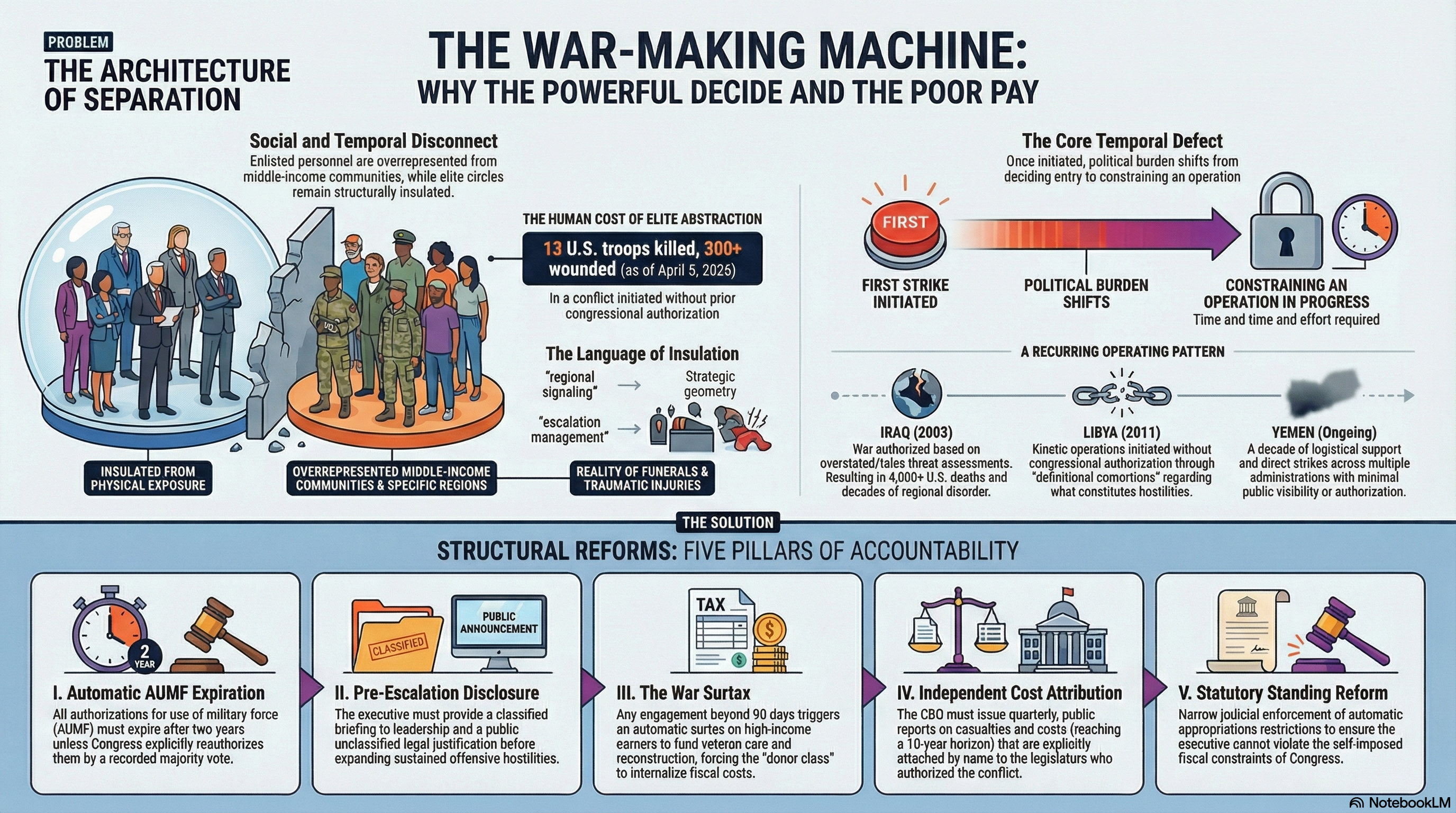
The people with the authority to initiate violence are often the people least exposed to its consequences. The people who debate escalation do not usually carry it. The people who frame it on television do not usually survive it. The people who preserve the political flexibility to support it or distance themselves from it are rarely the same people who have to execute it under fire, bury the dead, calm the families, or absorb the economic shock that follows.
That is not an accident. That is the system.
The clean language hides the dirty mechanics
The political class rarely speaks about war in plain human terms.
It speaks in phrases like deterrence, credibility, posture, signalling, regional stability, strategic necessity. These are not meaningless words, but they often function as insulation. They allow people at a safe distance to talk about force in a vocabulary abstract enough to protect them from the weight of what they are actually endorsing.
A missile strike becomes a message.
A death becomes a consequence.
A family becomes collateral.
A working-class service member becomes force projection.
The language is clean because the machinery is not.
And once the language gets clean enough, the moral friction drops. Escalation starts to sound procedural. Administrative. Manageable. That is how systems normalize behavior that would look monstrous if described honestly.
The real divide is not left versus right
The divide here is not primarily partisan. It is structural.
The real divide is between the people who can initiate conflict from safety and the people who must live inside the blast radius of those decisions, whether literal or economic.
That is why class matters here, but not in the lazy slogan sense. This is not just about income brackets. It is about exposure.
Who has the power to trigger force?
Who carries the legal and political cover?
Who gets the platform to explain it?
Who gets sent?
Who gets buried?
Who waits by the phone?
Who pays more at the pump, at the store, in taxes, in anxiety, in instability?
That is the hierarchy.
At the top are people buffered by office, institution, security, distance, and language. Below them are the operators, the families, the civilians in the target area, and the public expected to absorb the aftershocks while being told this is all necessary, limited, and under control.
That is not shared sacrifice. That is managed asymmetry.
Congress does not merely fail. It evades.
One of the clearest symptoms of this arrangement is the steady hollowing out of democratic war authorization.
In theory, the American system is supposed to impose friction before major violence. The Constitution and the War Powers framework exist because war is supposed to be difficult to initiate casually. The point is not bureaucracy for its own sake. The point is restraint.
But restraint is politically inconvenient.
Explicit authorization creates fingerprints. It creates ownership. It creates a record. If a war goes badly, the people who voted for it can be blamed for it.
So the incentive shifts. Better to posture than authorize. Better to comment than commit. Better to preserve ambiguity than accept responsibility.
That is how you get a system where Congress can complain about executive overreach while also refusing to act in ways that would truly limit it. That is not constitutional courage. That is career management.
And once that becomes normalized, presidential war power expands by default. Not always because the executive is brilliant or uniquely aggressive, but because the legislature discovers that paralysis is safer than responsibility.
The machinery still moves. Only accountability disappears.
The military is not the political correction mechanism
Civilians often misunderstand one crucial point.
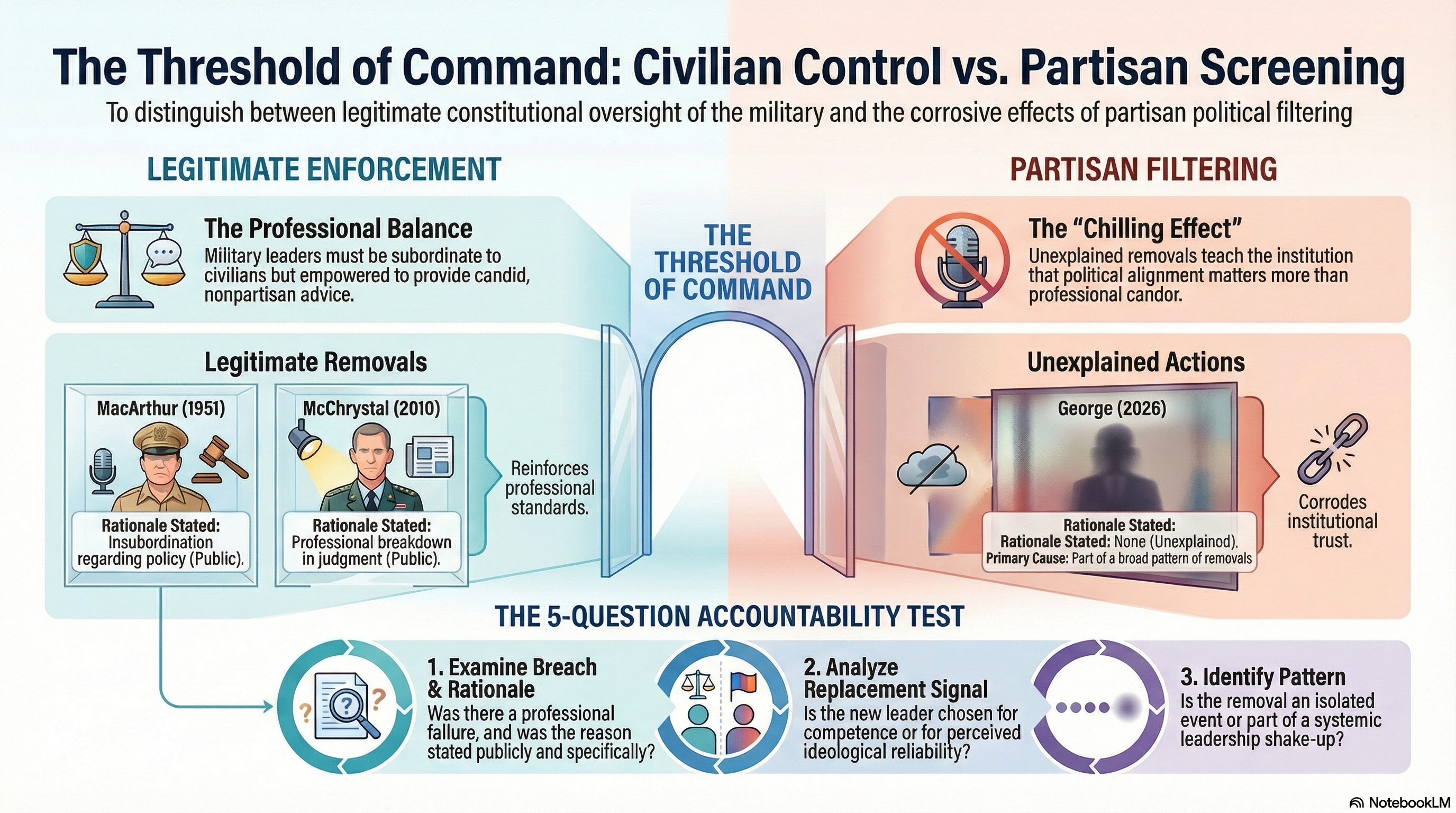
The military is not there to function as an independent political brake every time civilian leadership becomes reckless. In the American model, the military is subordinate to lawful civilian authority. That is a feature of the system, not a flaw.
But that truth makes the larger structure even more serious.
Because if the civilian leadership is politically insulated, if Congress is evasive, and if the media ecosystem can translate blood into abstraction, then the people who actually carry the burden of execution are trapped inside decisions they did not meaningfully make.
They still go.
They still fly.
They still clear.
They still rescue.
They still die.
That is where the class reality becomes unavoidable.
The people discussing escalation in climate-controlled rooms are not usually the ones trying to survive the consequences of miscalculation in the dark.
The public pays even when it is not deployed
One of the most dishonest habits in American political culture is pretending that war only costs the people in uniform.
That is false.
War hits the public through inflation, fuel prices, debt, instability, supply chains, stress, and the quiet normalization of emergency logic. Even those never sent overseas still absorb downstream consequences in their budget, their psychology, and their social environment.
The public pays in degraded trust.
In learned helplessness.
In permanent tension.
In the sense that enormous decisions happen overhead and after the fact.
That is why so many people are not merely tired of war but alienated from the people who narrate it. They understand, often more clearly than the experts give them credit for, that the burden is not distributed fairly.
They may not use institutional language for that insight. They may not cite legal doctrine. But they can feel the transaction.
They know who talks.
They know who sends.
They know who pays.
And they know those are usually not the same people.
This is what democratic erosion looks like
Democracy does not only erode through dramatic coups or obvious tyranny.
Sometimes it erodes through managed spectacle.
The rituals remain.
The speeches happen.
The press conferences continue.
The legal vocabulary survives.
The flags are still on stage.
But underneath the ceremony, the actual operating system changes.
Public consent becomes performative.
Legislative debate becomes symbolic.
Executive action becomes habitual.
Consequence flows downward.
Responsibility floats upward and disappears.
That is a different kind of regime problem. Not dictatorship in the theatrical sense, but a softer and more bureaucratic divorce between power and consequence.
And once that divorce becomes normal, war becomes easier to start, easier to narrate, and easier to survive politically for the people causing it.
Harder for everyone else, of course. But easier where it counts inside the machine.
The test is simple
A society should ask one brutal question before trusting its war architecture:
Do the people with the greatest power to initiate force bear meaningful personal, political, or material consequence for using it?
If the answer is no, then the system is already drifting.
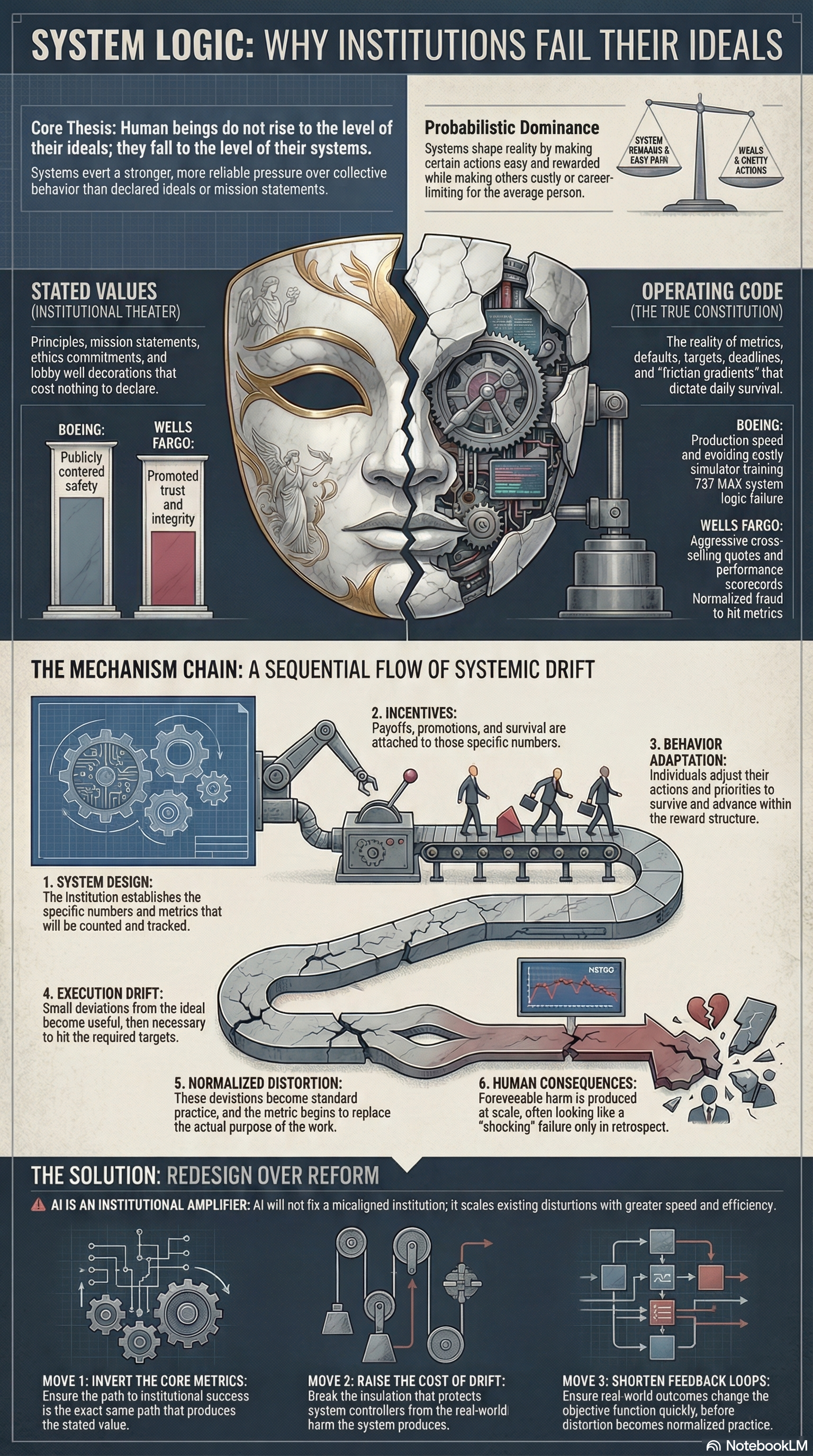
Because human beings do not rise to the level of their ideals. They fall to the level of their systems.
If the system allows insulated actors to trigger violence while offloading the danger onto troops, civilians, and working families, then eventually that is exactly what it will do. Repeatedly. Smoothly. Respectably.
That is not a bug. That is behavior under incentive.
And that is why the phrase matters:
A class system with missiles.
Not because it sounds sharp.
Because it describes the machinery.
If war remains easiest for the safest people to start, then democracy becomes theater and sacrifice becomes caste.
That is the truth most official language is built to hide.
Member discussion