How Internal Incentives Override Stated Values
Most organizations do not describe themselves by what they reward.
They describe themselves by what they aspire to.
That is why almost every institution has some polished language about integrity, service, excellence, trust, accountability, or innovation. The words are clean. The branding is clean. The website is clean. The annual report is clean. Human beings love ceremonial language because it lets them feel morally organized while the machinery underneath does something else.
But institutions are not ultimately defined by what they say.
They are defined by what they measure, reward, tolerate, and protect.
That is the real operating system.
And when that operating system conflicts with the official values, the values lose.
Not sometimes. Consistently.
Values Do Not Govern Behavior by Themselves
A stated value has no power on its own.
It is not a control mechanism. It is not an enforcement mechanism. It is not a feedback loop. It is not a consequence structure. It is just language unless it is built into decisions.
That is where many organizations fail their own people.
They assume that if a value is named, repeated, and displayed, it will shape conduct. But behavior is not trained by slogans. Behavior is trained by consequence.
People learn quickly what matters in any system:
- What gets tracked
- What gets praised
- What gets punished
- What gets ignored
- What gets people promoted
- What gets protected when results look good on paper
That is the curriculum.
The posted values are often just the brochure.
The Mechanism of Drift
Institutional failure rarely begins with a dramatic moral collapse.
It usually begins with a design choice.
A target is introduced. A metric is elevated. A performance standard is narrowed. A reporting structure is tightened. A career incentive is attached to visible output. A survival logic forms.
Then people adapt.
That adaptation is often rational inside the system, even when it becomes destructive outside the system.
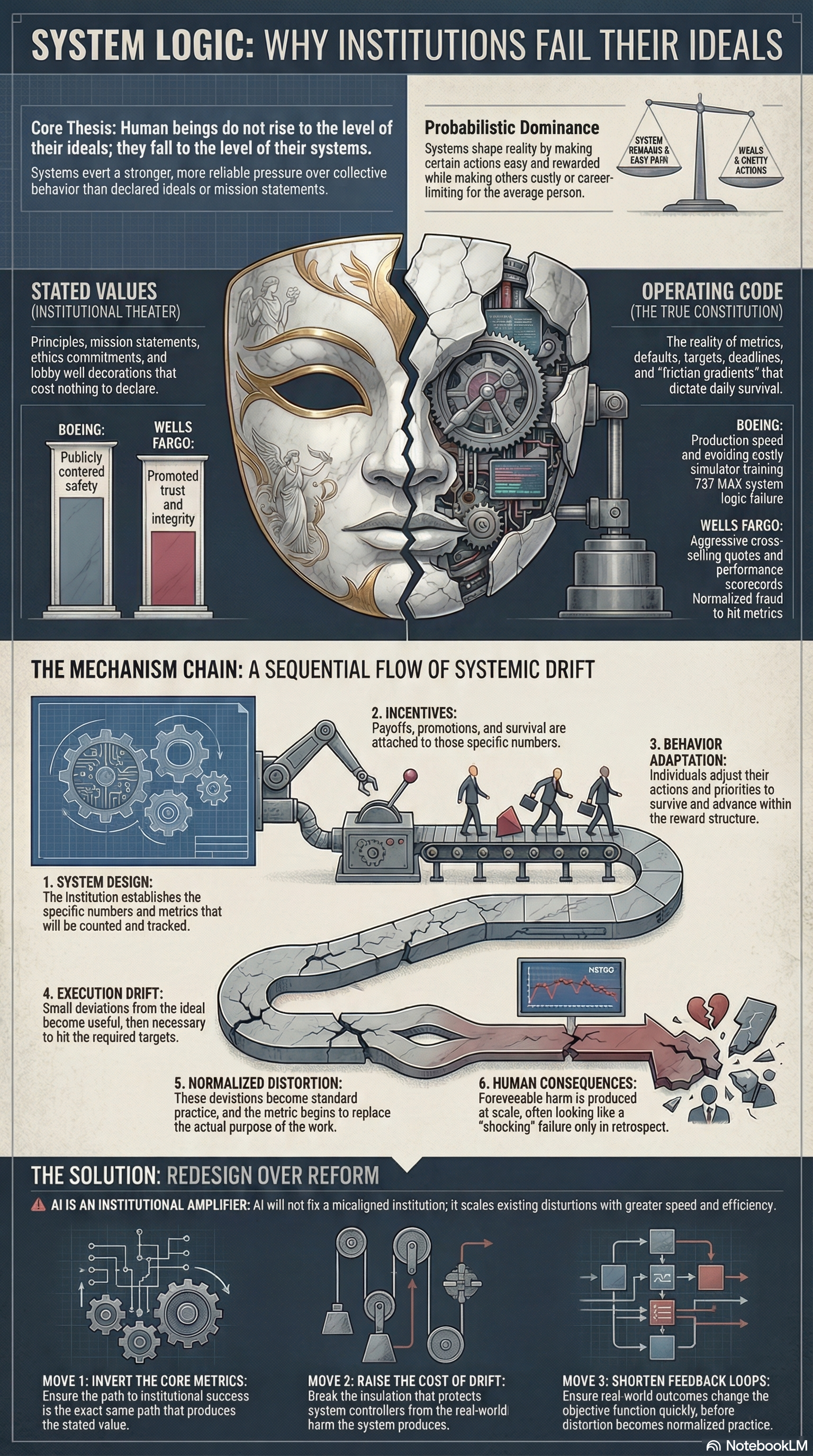
This is the mechanism chain:
1. System Design
The institution defines what counts.
It chooses what will be measured, tracked, ranked, reviewed, and escalated. This choice is never neutral. It tells the organization what reality matters.
2. Incentives
Payoffs, promotions, security, prestige, and protection become attached to those metrics.
Now the system has moved from aspiration to pressure.
3. Behavioral Adaptation
People begin adjusting their behavior to survive and advance within the incentive structure.
Even good people do this. Especially good people. They want to succeed. They want to belong. They want to remain effective. They do not wake up planning to betray the mission. They adapt to what the system actually rewards.
4. Execution Drift
The gap widens between stated mission and operational behavior.
People still repeat the values, but daily practice bends toward what gets results within the structure.
5. Normalized Distortion
Over time, the distortion stops feeling like distortion.
It becomes routine.
What would have once seemed clearly misaligned now looks practical, necessary, strategic, or simply “how things work here.”
6. Human Consequences
Eventually the cost leaves the spreadsheet and lands on real people.
Customers get harmed. Citizens lose trust. workers burn out. reporting becomes manipulated. safety declines. leadership credibility erodes. the institution begins producing outcomes opposite to its own stated purpose.
That is not hypocrisy as a personality flaw.
That is hypocrisy as a system output.
Why Good People Still Produce Bad Outcomes
One of the most dangerous myths in organizational life is that bad outcomes mostly come from bad individuals.
Sometimes they do.
But far more often, bad outcomes come from normal people responding predictably to misaligned incentives.
That matters because it changes the intervention.
If the problem is framed as a character problem, leaders respond with speeches, trainings, and culture statements.
If the problem is framed correctly as a systems problem, leaders have to examine:
- incentives
- reporting lines
- promotion structures
- measurement architecture
- enforcement asymmetry
- exception handling
- tolerance for politically convenient distortion
That is much more uncomfortable.
It is easier to lecture people about values than redesign the machine that overrides them.
Metrics Are Never Just Metrics
Every metric carries a hidden philosophy.
It tells people what the institution is willing to simplify, ignore, or trade away in exchange for a cleaner number.
The problem is not measurement itself. Serious institutions need measurement. The problem is when the metric becomes more career-relevant than the mission.
At that point, reality starts being shaped to satisfy the number.
A performance target meant to clarify execution becomes a pressure source. A pressure source becomes a behavioral driver. A behavioral driver becomes a distortion engine.
Then leadership gets confused and asks why culture is slipping.
Culture is slipping because culture follows pressure.
What Gets Rewarded Becomes Culture
Organizations love to talk about culture as if it is a mood.
It is not a mood.
It is a pattern.
And patterns come from reinforcement.
If people who cut ethical corners get protected because they hit numbers, that is culture.
If people who raise legitimate concerns get sidelined because they slow momentum, that is culture.
If leaders praise integrity in public but privately reward only speed, optics, and upward-friendly reporting, that is culture.
Culture is not the values page.
Culture is the repeated consequence pattern.
That is why organizations can sound principled and behave predatory at the same time. The language and the reinforcement structure are operating in different realities.
The Decorative Value Problem
This is where many institutional values become decoration.
Not false in the abstract. Just powerless in operation.
The value still exists as branding. It still appears in onboarding decks, keynote talks, websites, recruiting material, investor language, and internal messaging. But when pressure intensifies, it has no structural authority.
It cannot overrule the metric.
It cannot overrule the bonus structure.
It cannot overrule the reporting incentive.
It cannot overrule fear.
It cannot overrule career dependence.
So it survives only as performance.
And that is why people inside organizations often become cynical long before outsiders do. They can feel the split. They hear the values and watch the incentives contradict them every day.
Institutional Drift Does Not Need Villains
A system does not need mass corruption to malfunction.
It only needs enough misalignment to make the wrong behavior easier, safer, faster, or more career-compatible than the right behavior.
That is how institutional drift scales.
Not always through explicit orders.
Often through implied logic:
- do not make trouble
- make the quarter
- protect the team
- keep leadership happy
- maintain optics
- move fast
- be realistic
- stop overcomplicating things
- do not be the one who slows this down
None of these statements sound like open declarations against integrity.
That is the point.
Drift often speaks in the language of professionalism.
How to Tell What an Organization Really Values
Ignore the posters.
Ignore the speeches.
Ignore the branded value statements for a minute and study the structure.
Ask:
- Who gets promoted?
- Who gets protected after failure?
- What gets measured most aggressively?
- What kinds of truth create friction?
- What behavior is punished even when it is ethically correct?
- What results excuse bad conduct?
- What concerns are repeatedly minimized?
- What tradeoffs are treated as normal?
Those questions reveal the real value system.
An organization’s true values are visible in the pattern of what it rewards under pressure.
Pressure is where the costume falls off.
Why Leaders Miss the Problem
Many leaders are trained to read breakdowns in moral language instead of systems language.
So when trust erodes, they call for accountability.
When reporting degrades, they call for transparency.
When people disengage, they call for culture renewal.
When public backlash hits, they call for better communication.
Sometimes those things matter.
But if the incentive structure remains unchanged, the same distortions will regenerate.
That is the trap.
Leaders often try to solve structural contradictions with messaging. They try to restore belief without restoring alignment. They try to repair legitimacy cosmetically while leaving the behavioral engine intact.
That never lasts.
What Real Alignment Would Require
If an institution actually wants its values to govern behavior, those values must be translated into operating architecture.
That means:
- embedding them into measurement systems
- tying them to promotion and accountability
- protecting people who surface inconvenient truth
- penalizing outcomes achieved through destructive shortcuts
- rewarding mission-consistent behavior, not just metric compliance
- auditing whether internal incentives contradict public claims
Values have to become expensive to violate and practical to uphold.
Otherwise they remain ceremonial.
The Core Lesson
The issue is not that values do not matter.
The issue is that values without structure are weak.
Institutions drift when they ask language to defeat incentives.
It cannot.
A poster cannot beat a promotion system.
A slogan cannot beat a compensation model.
A town hall cannot beat survival logic.
A training module cannot beat an architecture that rewards distortion.
So the real question is not whether your organization has good values.
The real question is whether the system underneath those values is designed to uphold them when pressure arrives.
Because pressure is always coming.
And when it does, human beings do not rise to the level of institutional aspiration.
They fall to the level of institutional design.
Final Line
If you want to know what an organization truly believes, do not start with what it says.
Start with what its people must do to survive inside it.

Member discussion