I Was Afraid of AI. Then I Used It to Rebuild My Life.
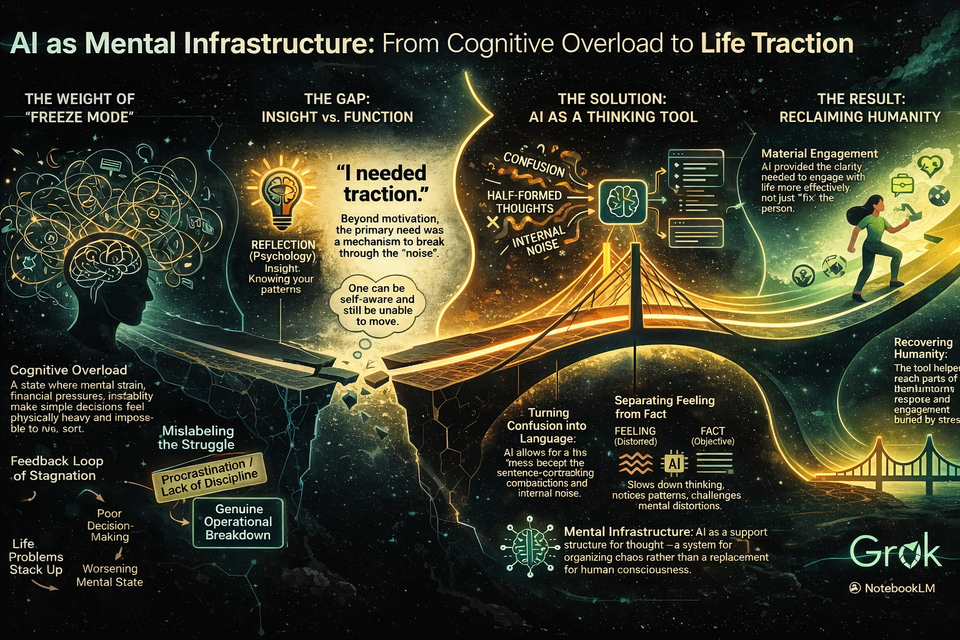
I Was Afraid of AI. Then I Used It to Rebuild My Life.
I did not come to AI for hype, productivity tricks, or prompt libraries. I came to it because my life was under pressure, my mind was overloaded, and I needed a way to think clearly enough to function
When I was a kid in the 90s, AI felt like something you were supposed to fear.
That was the script.
Machines get smarter. Humans lose control. The future turns cold. Somewhere in the background there was always Terminator, always some version of the same warning: one day the system wakes up, and when it does, we are finished.
I remember thinking, even back then, that if that day ever came, the only way to beat them might be to join them.
I meant it as a joke.
Turns out it was more honest than I knew.
I Did Not Come to AI for the Reasons People
Usually Talk About
I did not come to AI because I wanted to feel futuristic.
I did not come to it because I was chasing hype, trying to become a better prompt engineer, or looking for another digital trick to make me look ahead of the curve.
I came to it because my life was not working.
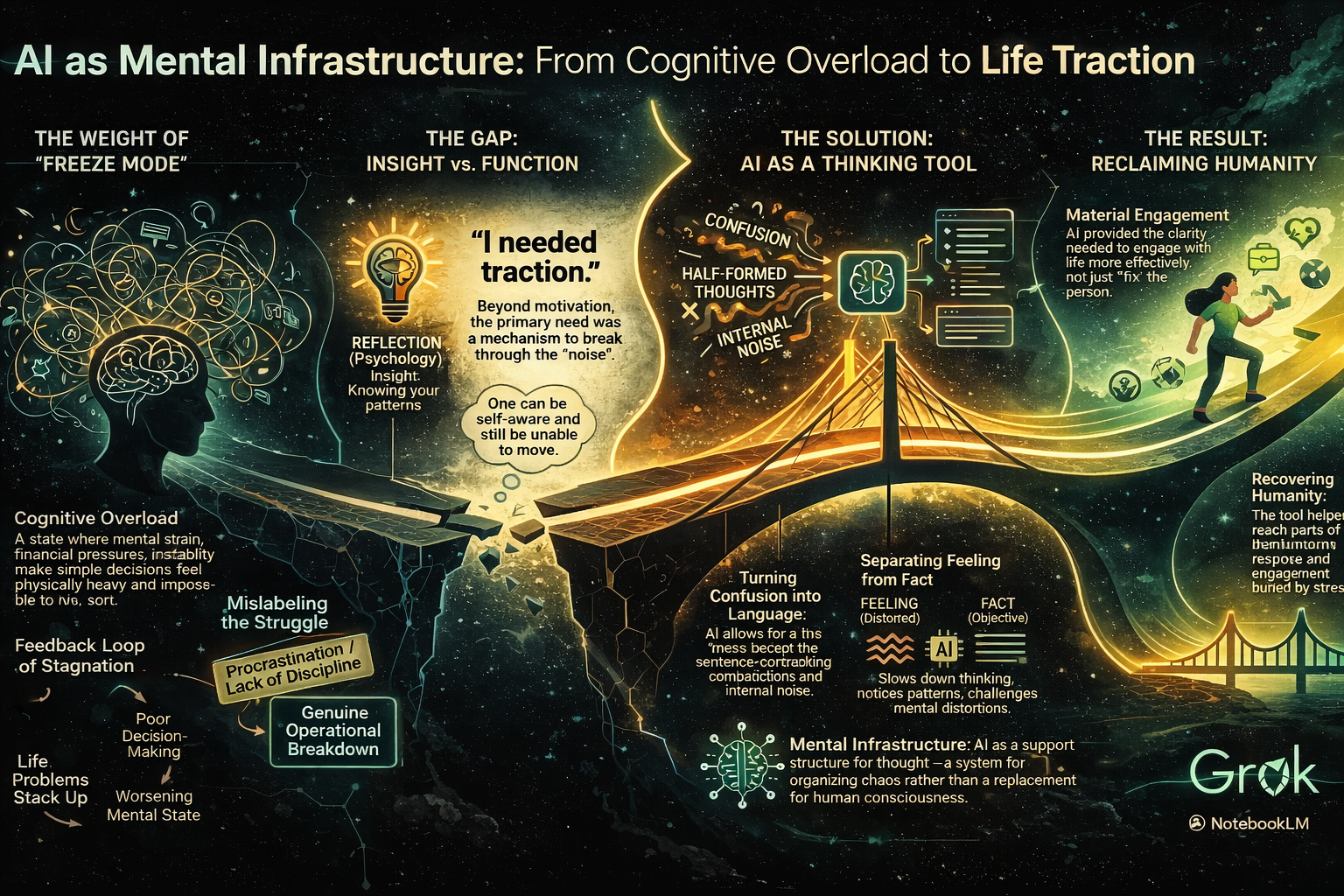
I was dealing with mental strain, financial pressure, instability, bills, stress, and the kind of internal overload that makes even simple decisions feel heavier than they should. I felt stuck for years.
Not lazy.
Not indifferent.
Stuck.
There is a difference.
From the outside, that kind of state gets mislabeled all the time. People call it procrastination. Lack of discipline. Inconsistency. Bad habits. They like clean labels because clean labels let them avoid messy realities.
But from the inside, it did not feel like laziness.
It felt like watching things pile up while part of me could not fully move.
It felt like seeing what needed to be done and still struggling to act.
It felt like living under enough cognitive and emotional weight that everything became harder to sort, harder to prioritize, and harder to begin.
The Real Breakdown Was in My Ability to Think Clearly
What I was dealing with was not just pain.
It was impaired clarity.
That part matters because people often talk about struggle as if it lives only in feelings, while ignoring the operational side of it: attention, sequencing, prioritization, decision-making, follow-through.
When your mind gets overloaded, ordinary life starts feeling heavier than it is.
Bills become heavier.
Choices become heavier.
Communication becomes heavier.
The future becomes heavier.
Everything starts costing more mentally than it should.
Then the loop gets worse.
The more overloaded you get, the harder it becomes to make clean decisions. The harder it becomes to make clean decisions, the more life stacks up around you. Then the stacked-up life creates more pressure, which makes thinking worse.
At some point, a person does not just need motivation.
They need traction.
That Is Where AI Entered My Life
At first, I did not trust it.
I carried the same cultural fear a lot of people carry. AI was supposed to be dangerous, dehumanizing, maybe useful in some distant abstract way, but not something you invited into your actual inner life.
Then I started using it.
What I found was not magic.
It was not salvation.
It was not consciousness.
It was not a replacement for being human.
It was a tool that could help me think when my thinking was tangled.
That mattered immediately.
Reflection Was Not Enough
I had gone to psychologists. I had tried to talk things through. I had tried to understand myself. Some of that helped.
But there was still a gap between insight and function.
You can understand yourself and still struggle to act.
You can know your patterns and still feel stuck inside them.
You can be self-aware and still not know what to do next.
That was the gap I was living in.
I did not just need reflection.
I needed help sorting thoughts, organizing problems, breaking overload into parts, and making decisions when my own mind was noisy.
That is what AI started doing for me.
Not perfectly. Not all at once. But enough that I noticed the difference.
The Real Value Was Clarity
The deepest value of AI for me was not speed.
It was clarity.
It gave me a place where I could bring the mess before the sentence. Before the polished version. Before the explanation. Before the performance.
I could bring confusion.
I could bring fear.
I could bring contradiction.
I could bring half-formed thoughts.
I could bring internal noise.
And instead of staying trapped inside all of it, I could start sorting it.
AI helped me slow my thinking down enough to examine it. It helped me separate feeling from fact. It helped me notice patterns in what I was saying. It helped me challenge distortions. It helped me turn emotional overload into language, and language into decisions.
That did not make pain disappear.
But it made reality easier to work with.
And when your life feels unstable, that is not small.
It is a lifeline.
AI Did Not Fix Me
This part matters because people overstate everything and then act surprised when reality refuses to cooperate.
AI did not fix me.
It did not heal me.
It did not replace therapy.
It did not remove responsibility.
It did not solve financial pressure by itself.
It did not erase pain.
What it did do was help me engage my life more clearly.
It helped me ask better questions.
It helped me think in steps instead of spirals.
It helped me move from overwhelm to analysis.
It helped me translate vague suffering into specific problems.
That changed things.
I Was Not Looking for Comfort Theater
I was not looking for fake affirmation.
I was not looking for a machine to tell me I was brilliant while my life stayed broken.
I was not looking for another distraction dressed up as progress.
I was looking for something useful.
Something that could help me sort through mental clutter.
Something that could help me think through real decisions.
Something that could help me regain traction.
Something that could help me interact with my own life with more clarity and less noise.
That is what I found.
Underneath All of This Was Exhaustion
Not dramatic, cinematic exhaustion.
The quieter kind.
The kind that builds when you have been carrying too much for too long. The kind that comes from trying, failing, recalibrating, trying again, and slowly feeling your margin get thinner.
That kind of exhaustion is dangerous because it does not always look dramatic from the outside.
Sometimes it just looks like delay.
Withdrawal.
Inconsistency.
Lost time.
Reduced urgency.
A person becoming less visible inside their own life.
But inside, it can feel like a slow surrender.
That is why useful tools matter.
When someone is trying to hold their life together, usefulness matters more than performance.
Why I Take AI Seriously
I did not meet AI from a place of luxury.
I met it from a place of need.
I was trying to understand myself.
I was trying to regain control.
I was trying to think more clearly.
I was trying to stop my life from falling apart in slow motion.
I was trying to find a way to operate again.
So when I talk about AI, I do not talk about it like a toy.
I talk about it like infrastructure.
A support structure for thought.
A tool for reflection.
A system for organizing mental chaos.
A way to turn confusion into language and language into action.
That does not mean AI is harmless. Any powerful tool deserves scrutiny. Humans have a long and embarrassing habit of turning every useful invention into a surveillance device, a status game, an addiction engine, or a mechanism for concentrating power. No reason to think AI will be spared that pattern.
But fear by itself is still incomplete.
The better question is not just whether AI is dangerous.
The better question is: dangerous in whose hands, useful for what, and compared to what existing failures?
Because I know what untreated mental overload feels like.
I know what freeze mode feels like.
I know what it means to watch life accumulate faster than your mind can process it.
I know what it is like to need help, not in some abstract philosophical sense, but in the practical sense of needing a way to think more clearly so you can function.
Against that background, AI was not simply the threat I had been taught to fear.
It was, at times, the bridge.
Final Truth
For me, AI was never primarily about escaping humanity.
It was about recovering access to parts of my humanity that stress, confusion, instability, and overload had made harder to reach.
Not magically.
Not perfectly.
But materially.
That is why this matters to me.
I was afraid of AI before I understood it.
Then I used it.
And what I found was not a machine trying to replace me.
What I found was a tool that helped me rebuild my ability to think, respond, and engage my own life with more structure and less confusion.
I did not start using AI because I wanted to become less human.
I started using it because I was trying to hold my life together.
And in that season of my life, it helped me do exactly that.
Closing
I was taught to fear AI as the thing that might one day take humanity away.
What I found instead was something far more human:
used the right way, it helped me recover my own.
**A few questions I expect will come up — answered here before the comment section generates them.**
---
**”Are you saying structured prompts are bad?”**
No. The piece explicitly defends Standalone Prompts as the right tool when context is low, tasks are technical, or outputs need to be portable across systems or people. The argument is about misapplication — using structural overhead where signal clarity would do the job faster and with less drag. Those are compatible claims.
---
**”I’m a beginner. Should I stop using templates?”**
Not yet. Borrowed Structure is Stage 1 of the three-stage model for a reason — it is the correct starting point when your own standards are not yet defined. Use templates as a training set. React to what they produce. Extract what you actually prefer. The problem is permanent template dependence, not templates themselves.
---
**”’Operational clarity’ sounds subjective. You replaced one vague concept with another.”**
The Master Dictionary section exists precisely to address this. Operational clarity is not a mood — it is a measurable condition: can you define what good looks like before you start, and can you recognize the gap between the output and that definition? If yes, you have it. If not, you do not. The Master Dictionary is the mechanism for making subjective standards operationally stable and reproducible.
---
**”This only works if the model remembers everything. Most people use fresh sessions.”**
The five-layer context model is designed for this. Layers 3 and 4 — Persistent Instructions and External Source Documents — are model-agnostic and session-independent. A Master Dictionary, a persistent instruction layer, and a source document survive a session reset, a model update, and a platform switch. The architecture lives above the chat, not inside it. Earned Compression does not require chat continuity. It requires that the right context lives in the right layer.
---
*Full piece above. All objections fair game in comments.*
Thanks for reading! This post is public so feel free to share it.
Member discussion