
Lawful and Corrosive
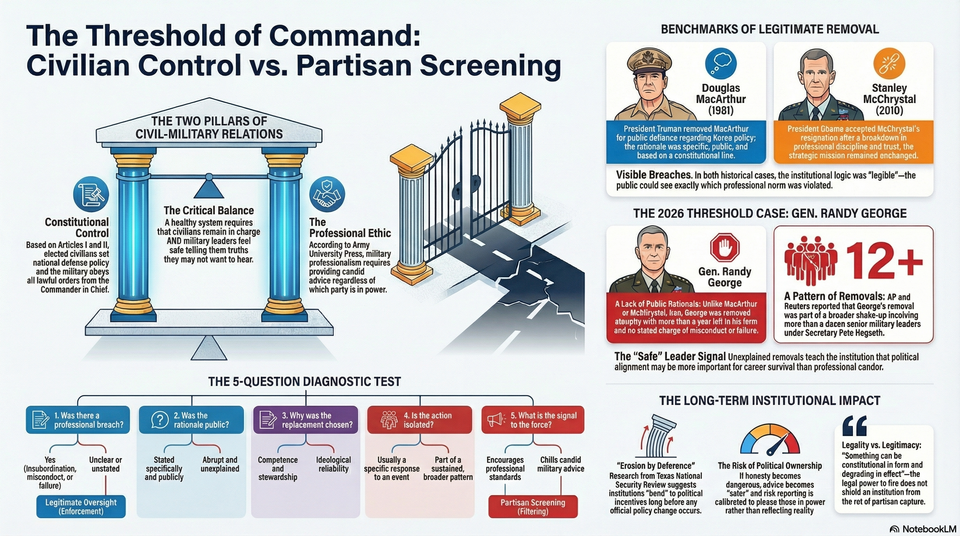
The American military is not designed to be independent of civilian authority. It is designed to be subordinate to elected leadership while remaining professionally nonpartisan. That balance is the whole game. The danger begins when civilian control stops being a mechanism for directing policy and enforcing standards and starts becoming a filter for political and ideological reliability. That is the threshold where legitimate oversight drifts into partisan screening.
The April 2026 removal of Army Chief of Staff Gen. Randy George is worth examining on those terms. The question is not whether civilians can remove generals. They can. The question is what repeated unexplained removals teach the institution about what kinds of leaders are safe to become, and what kinds of candor are dangerous. Reuters and AP reported that George was pushed out abruptly, with more than a year left in his term, effective immediately, amid a broader pattern of senior leadership shake-ups under Defense Secretary Pete Hegseth.
Civilian Control Is Necessary. Partisan Filtering Is Something Else.
Article II makes the president commander in chief. Article I gives Congress the power to raise and regulate the armed forces. That structure gives elected civilians broad authority over military leadership and defense policy. But constitutional control was never meant to produce a military selected for partisan safety. It was meant to produce a military that serves the constitutional order rather than a faction within it.
That distinction matters because legality alone does not answer the institutional question. Something can be lawful and still be corrosive. The legal authority to remove a senior officer is clear. The institutional consequences of how that authority is exercised are a separate question entirely.
The Other Half of the Architecture
Civilian control is only half the system. The other half is the professional nonpartisan ethic. Army University Press frames that ethic as a core component of military professionalism — tied directly to civilian control, public trust, and the obligation to provide candid advice regardless of which party holds office. The goal is not a politically sterile officer corps. The goal is an officer corps that is not politically owned.
A functional civil-military system requires two conditions simultaneously: civilian leaders must be in charge, and military leaders must still be able to tell them things they do not want to hear. When the second condition erodes, the institution does not need to become openly partisan to become politically bent. It only needs to learn what kinds of honesty are career-ending.
What Legitimate Enforcement Looks Like
Not every firing is politicization. Some are exactly what civilian control is supposed to look like.
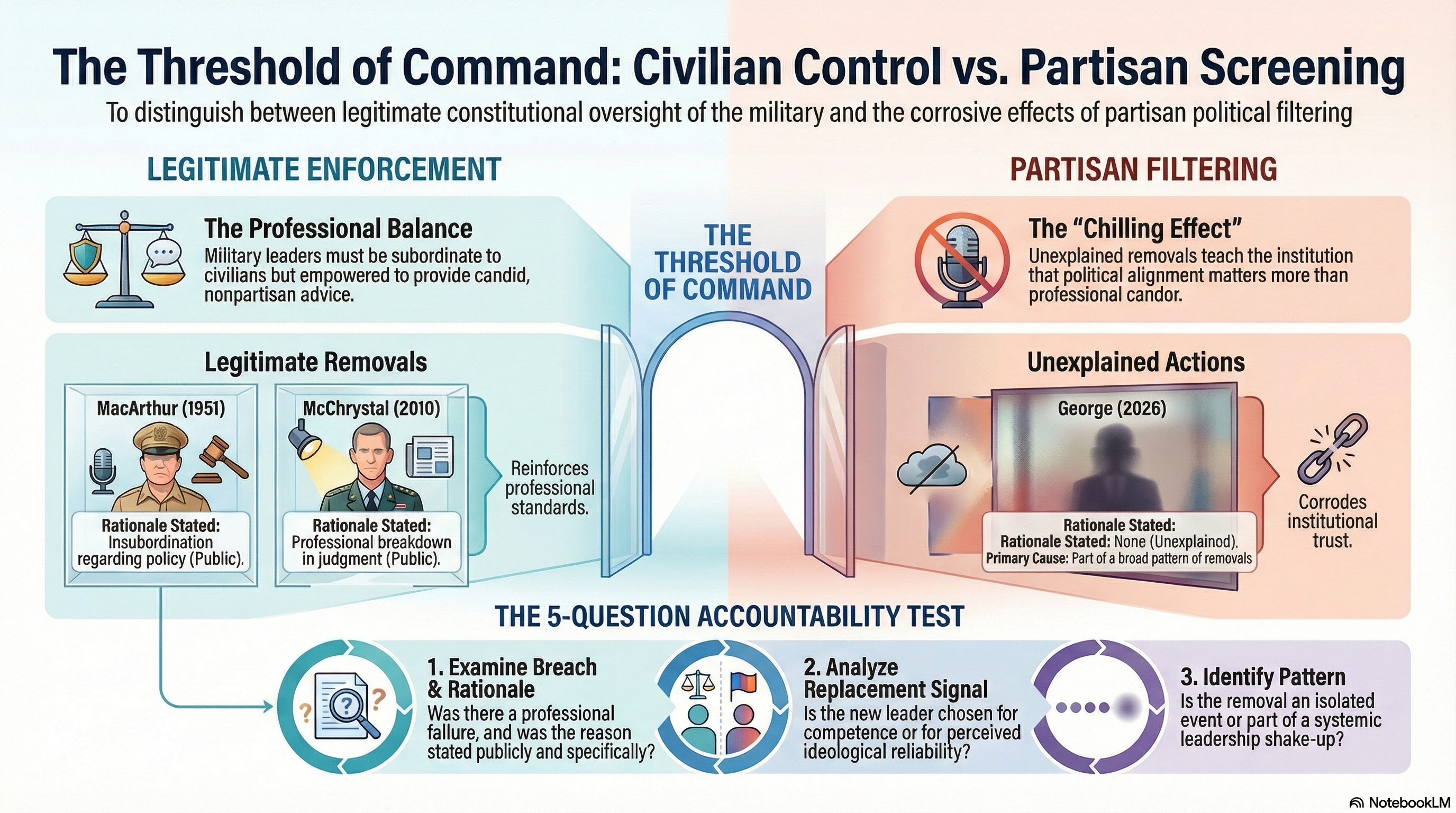
Harry Truman’s removal of Gen. Douglas MacArthur in 1951 is the benchmark. In Truman’s own words, MacArthur was “unable to give his wholehearted support” to U.S. and UN policy in matters pertaining to his official duties. That was not an ideological test. It was the enforcement of a constitutional line: a general does not get to set national policy over the elected commander in chief. The breach was public. The rationale was stated. The institutional logic was legible.
The 2010 removal of Gen. Stanley McChrystal follows the same logic. After a Rolling Stone profile exposed contemptuous remarks by McChrystal’s staff toward senior civilian officials, President Obama accepted his resignation, installed Gen. David Petraeus, and preserved strategic continuity while reinforcing the principle that professional discipline and trust inside the chain of command are not optional. The issue was professional breakdown, not ideology. The replacement decision signaled competence, not compliance.
In both cases, the breach was visible, the rationale was public, and the action reinforced institutional standards rather than partisan loyalty.
Why the George Case Is Different
The George case is different because no breach has been made visible.
On the public record, there is no stated charge of insubordination, misconduct, or professional failure. Reuters reported that George had more than a year remaining in his term when Hegseth asked him to step down, that the Pentagon offered no public explanation, and that the retirement was effective immediately. AP reported the move as part of a significant leadership shake-up in which more than a dozen senior military leaders were removed during Hegseth’s tenure.
That does not establish partisan screening as a settled fact. It places the case in a different category. MacArthur was public defiance. McChrystal was professional breakdown. George — at least on the current record — is a threshold question: ordinary leadership reshaping within the scope of civilian control, or an unexplained removal pattern that begins teaching the force that political safety matters as much as professional candor.
Personnel Decisions Are Signals
Senior removals are not just personnel actions. They are institutional signals. They teach the force what gets rewarded, what gets punished, what kinds of candor are survivable, and what kinds of leaders are worth becoming.
Research in Texas National Security Review warns that civilian control erodes not only through open military defiance but through patterns of deference that quietly reshape behavior. The profession adapts before the doctrine changes. The culture bends before any policy memo appears.
That is why unexplained removal patterns matter. Remove leaders for clear professional reasons, and civilian control is reinforced. Remove them abruptly, without stated rationale, in a sustained pattern, and the institution begins to receive a different signal: that candor has costs, that advice should be politically calibrated, and that risk reporting must account not only for battlefield reality but for the preferences of the people above you. Serious institutions do not degrade in a single dramatic act. They are worn down by repeated signals that teach everyone what survival requires.
Five Questions That Separate Enforcement from Screening
The cleanest way to distinguish lawful civilian control from partisan filtering is five questions:
Was the officer removed for insubordination, misconduct, strategic failure, or another identifiable professional breach?
Was the rationale stated publicly and specifically?
Does the replacement appear chosen for competence, or ideological reliability?
Is the action isolated, or part of a sustained pattern?
Will the signal encourage candid military advice, or narrow it?
MacArthur and McChrystal answer those questions clearly. The breach was visible. The rationale was legible. The institutional logic held. George does not — at least not yet. What can be said with confidence: presidents and defense secretaries have wide authority over military leadership, and not every controversial removal is politicization. What remains open: whether the current pattern represents ordinary restructuring, unusually aggressive consolidation, or systematic screening for political reliability.
The Real Question
The real issue is not whether civilians are in charge. They are. They are supposed to be.
The real issue is what kind of military their methods are producing. Personnel decisions teach the institution what kinds of judgment are protected, what kinds of honesty are dangerous, and what kinds of officers are safe to become. Remove leaders for clear professional reasons, and civilian control is reinforced. Remove them in unexplained patterns, and the institution learns a different lesson. By the time an institution is willing to admit it has become politically bent, the lesson has usually been learned long before.
Reuters, April 2, 2026: US Army chief of staff fired by Hegseth, sources say
Truman Library: Statement and Order by the President on Relieving General MacArthur of His Commands
Army University Press: Instilling the Nonpartisan Ethic at the Unit Level
Obama White House Archives, June 23, 2010: President Obama on Afghanistan, General McChrystal & General Petraeu
Member discussion