Our Leaders Have Failed Us
I am not writing this as a pundit.
I am not writing this as an academic, a politician, or a man who built his opinions from headlines and safe distance.
I am writing this as someone who put boots on the ground.
I am writing this as someone who trusted the system enough to serve it, then came home and learned how hard institutions work to avoid responsibility for the people they change.
And I am writing this because the truth is now too obvious to ignore:
our leaders have failed us.
Not just in one country. Not just in one administration. Not just in one war.
They have failed at the level that matters most. They have failed to evolve leadership itself to match the danger, speed, and complexity of the world we now live in.
We are still trapped in the same civilizational loop.
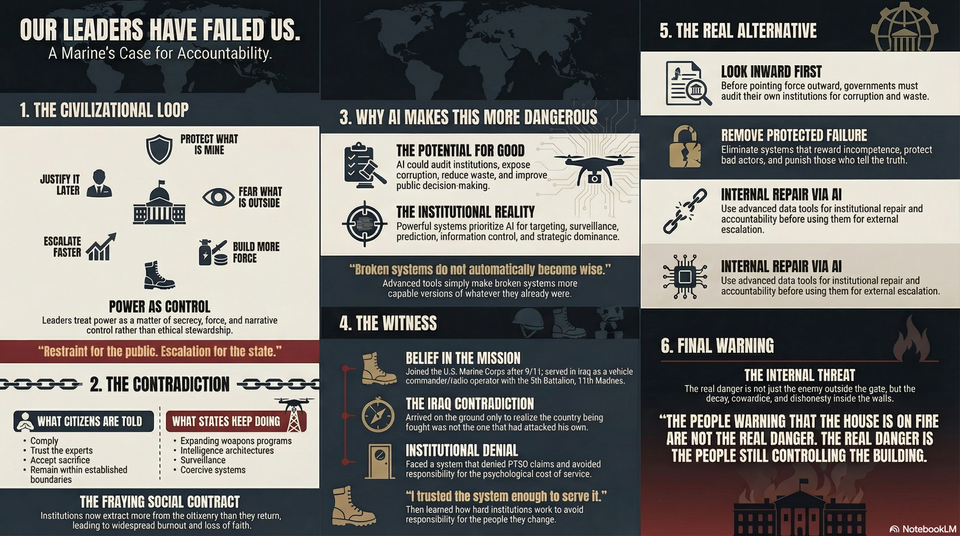
Protect what is mine. Fear what is outside. Build more force. Escalate faster. Justify it later.
Dress it up in the language of security, deterrence, freedom, democracy, order, peace, or national interest. The slogan changes. The logic does not.
Now we are entering an age shaped by artificial intelligence, mass surveillance, strategic data infrastructure, automated warfare, institutional distrust, and rising instability, and the people steering humanity through it still act like power is mainly about secrecy, force, and narrative control.
They speak about peace while preparing for escalation.
They speak about law while hiding behind exceptions.
They speak about public trust while asking citizens to accept standards they would never accept for themselves.
That is the contradiction at the center of modern leadership:
restraint for the public, escalation for the state.
Ordinary people are told to comply, trust the experts, stay calm, accept sacrifice, and remain inside the boundaries.
Meanwhile governments expand weapons programs, intelligence architectures, coercive systems, military readiness, and now the race to build AI-enabled systems of conflict.
Citizens are expected to surrender power.
States are expected to accumulate more of it.
And somehow this is sold as stability.
It does not look like stability.
It looks like governments building larger and more efficient systems of force while ordinary people are broke, burned out, isolated, overworked, confused, and losing faith in the future.
It looks like billions flowing toward strategic dominance while communities decay from the inside.
It looks like leaders preparing for competition, control, and conflict while speaking the language of peace.
And people feel it.
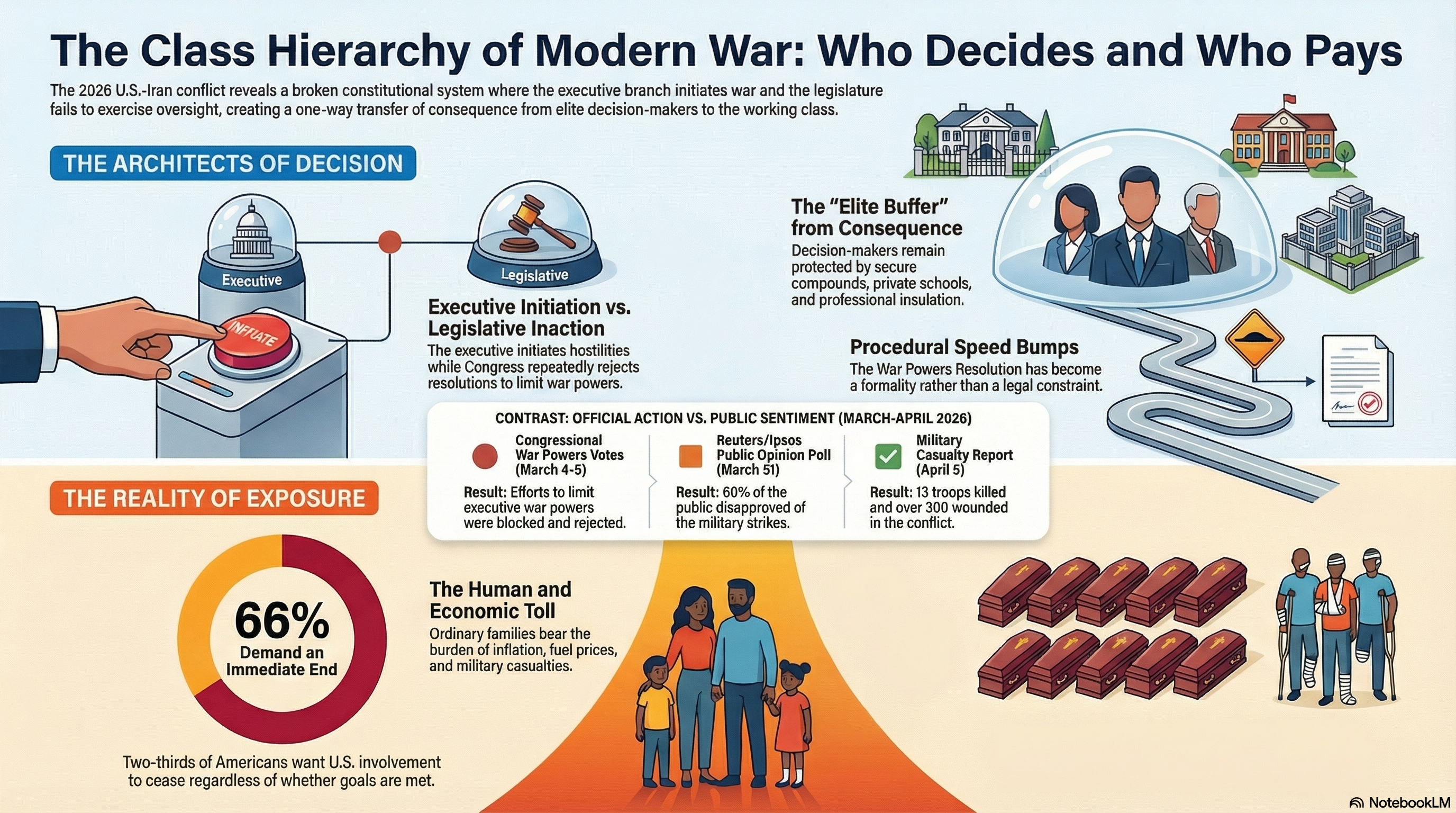
Even when they cannot explain it in clean policy language, they feel that something is wrong. They feel that the social contract is fraying. They feel that institutions extract more than they return. They feel that the people making the biggest decisions are often the least exposed to the consequences.
That instinct is not irrational.
It is observation.
In the age of AI, this contradiction becomes even more dangerous.
Because AI could be used to help societies audit themselves, expose corruption, reduce waste, improve public administration, strengthen accountability, and raise the quality of decision-making.
Instead, one of the first things powerful institutions want from it is strategic advantage.
Better targeting.
Better surveillance.
Better prediction.
Better information control.
Better dominance.
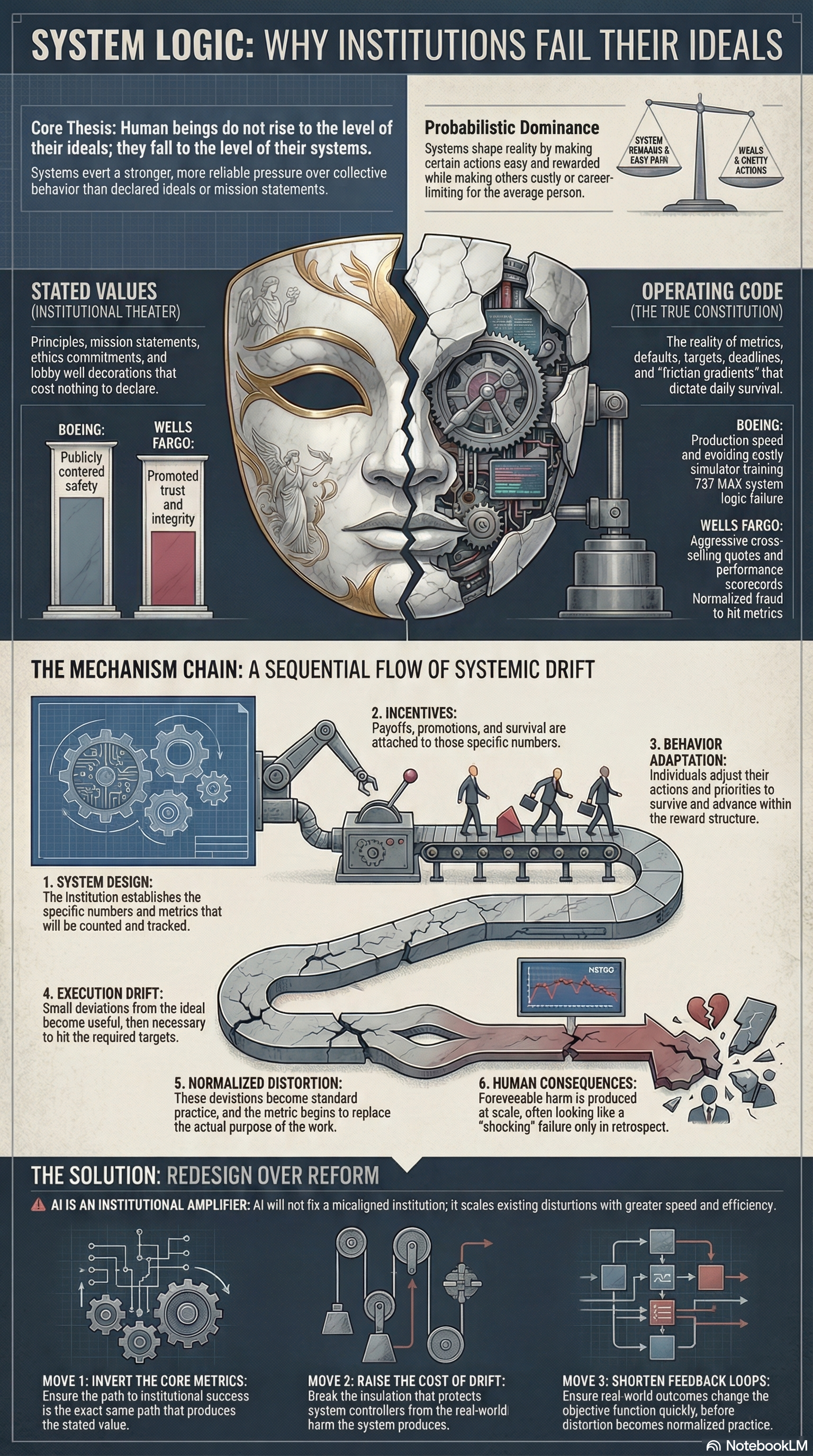
Humanity keeps proving the same point over and over: when new tools arrive, broken systems do not automatically become wise. They become more capable versions of whatever they already were.
That is the danger.
Not just bad people.
Not just bad policy.
Broken systems amplified by advanced tools.
My view is simple.
Before any government points outward, it should be forced to look inward.
Audit the institutions.
Find the corruption.
Find the waste.
Find the officials violating constitutional principles, public trust, or basic fiduciary responsibility.
Find the people collecting paychecks while contributing nothing except delay, stagnation, and bureaucratic cover.
Find the systems that reward failure, protect incompetence, and punish truth-telling.
Remove them.
There should not be one standard for ordinary citizens and another for political leaders, senior bureaucrats, defense contractors, military leadership, and the insulated classes of decision-makers who keep society running just well enough to survive while quietly draining its legitimacy.
If institutions can demand sacrifice, discipline, accountability, and obedience from citizens, then citizens have every right to demand real accountability from the institutions governing them.
That is not radical.
That is legitimacy.
I say this not as an outsider performing outrage from a safe distance, but as someone who once believed deeply in the mission.
After 9/11, like many Americans, I believed.
I remember where I was.
I remember the atmosphere.
I remember what was said.
I was young. I was angry. I believed that if someone attacked my country, a response had to follow. I joined the United States Marine Corps because I believed service meant something real. I believed there was honor in going where the danger was. I believed there was meaning in standing between your people and those who would harm them.
I was willing to run toward the gunfire.
I was willing to do what my country asked of me.
But when I got to Iraq, one of the first things I said to myself was this:
this country did not attack us.
That realization does not leave you.
Once boots are on the ground, politics disappear for the people carrying the weight. The mission becomes survival. Loyalty becomes local. The cost becomes personal. The story told back home becomes something else entirely, shaped by institutions that can edit, justify, delay, and reframe reality long after the people sent to carry it have come back changed.
I came home changed.
And when I tried to seek help, I ran into another side of the machine.
I was denied my claim for PTSD because they said it was not service-connected. A German doctor disagrees. Since last year, I have been trying to pull myself together and get help, and at times it has felt almost impossible.
That is another failure of leadership people do not want to sit with.
It is one thing to send men into the machine.
It is another thing to look away when the machine comes home inside them.
So when I say our leaders have failed us, I am not speaking in abstractions.
I am speaking as someone who trusted the system enough to fight for it, then learned what happens when that same system no longer wants to take responsibility for what it created.
That matters.
Because one of the ugliest habits of failed institutions is this: they isolate the witness.
They make the person carrying the contradiction look unstable, bitter, irrational, or disposable.
They pathologize the human response while protecting the structure that produced it.
I reject that.
I am not crazy because I see the contradiction.
I am not weak because I refuse to lie about what I lived through.
I am not dangerous because I believe leadership should be accountable before it drags nations into catastrophe.
What is dangerous is a world in which aging political classes, outdated bureaucracies, captured institutions, and insulated elites continue making civilization-level decisions with twentieth-century instincts and twenty-first-century tools.
What is dangerous is a world in which AI is treated first as a weapon, a surveillance layer, or a control architecture instead of a tool for institutional repair.
What is dangerous is a world in which leaders still believe they can manage reality through slogans while ordinary people are forced to live inside the consequences.
My generation should be saying this clearly:
enough.
Enough with the recycled thinking.
Enough with the permanent state of strategic drift.
Enough with leaders too old, too insulated, too compromised, or too detached to understand the systems now coming online.
Enough with governments that can move at lightning speed when they want compliance, but suddenly become helpless, procedural, and confused when the subject is corruption, reform, waste, accountability, or peace.
Enough with the double standard.
Leadership is not sacred.
It is conditional.
If leaders cannot reduce corruption, reform institutions, prevent reckless escalation, and use modern tools to serve the public rather than entrench themselves, then they do not deserve automatic deference.
They deserve scrutiny.
They deserve challenge.
And if they continue failing at civilizational scale, they deserve replacement.
That does not mean chaos.
It means accountability.
It means institutional audit before external escalation.
It means constitutional seriousness.
It means using AI to expose internal rot before using it to sharpen external force.
It means rebuilding legitimacy at home before pretending to defend values abroad.
It means accepting a truth most systems hate:
the real threat is not only the enemy outside the gate. It is also decay, cowardice, corruption, and dishonesty inside the walls.
I am not writing this because I want more anger in the world.
I am writing this because I want less fraud.
I do not want to be ruled by anger anymore.
I do not want to become the kind of man broken systems manufacture.
I do not want future generations inheriting stronger machines and weaker leadership.
I want truth.
I want accountability.
I want serious reform.
I want leaders who can look inward before they point outward.
I want institutions that serve the people instead of feeding on them.
I want my generation to stop handing civilization over to stale minds and inherited inertia just because that is how it has always been done.
And I want people to stop confusing moral clarity with instability.
The people warning that the house is on fire are not the real danger.
The real danger is the people still controlling the building.
Member discussion