Perishable Labor, Durable Moats
A creator can spend years building an audience and still find out, in one bad month, that the audience was never fully theirs.
That is the central illusion of the creator economy.
The popular story sounds liberating. You do not need a studio, a publisher, a television network, or a newspaper editor to reach people anymore. You can publish from your phone. You can build from your bedroom. You can film, write, stream, edit, upload, and find an audience without waiting for institutional permission.
Compared to the old media world, that feels like freedom.
And at the level of production, it is.
But production freedom is not the same thing as structural independence.
That is where most of the public conversation goes soft. It mistakes the ability to post for the ability to own the system in which posting becomes valuable.
The creator economy did not remove gatekeepers. It replaced visible gatekeepers with infrastructural ones.
The editor became the ranking model.
The commissioning desk became the recommendation system.
The contract meeting became a dashboard, a monetization threshold, and a terms-of-service page that can change without negotiation.
Control did not disappear. It moved.
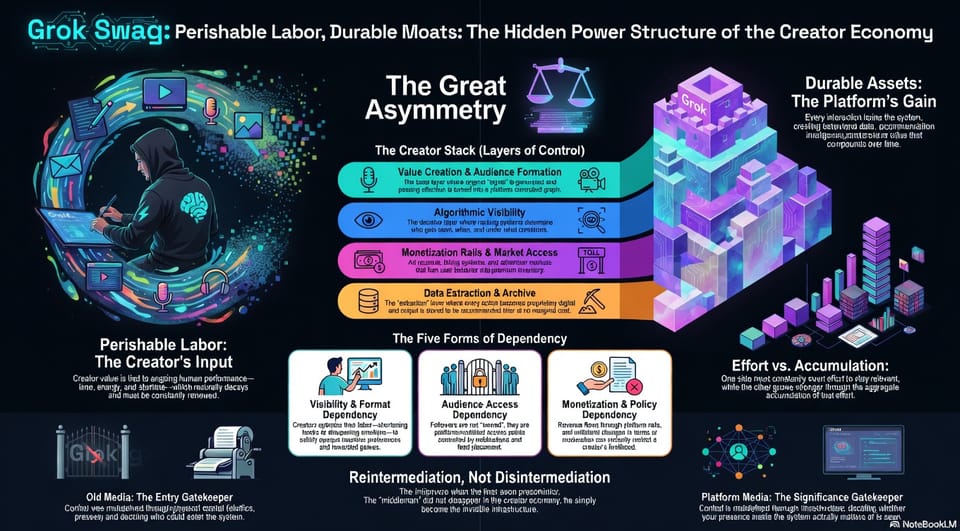
Creators now supply the human inputs that make platforms worth visiting in the first place: performance, personality, narrative, cultural energy, emotional connection, trust, attention. Platforms take those perishable inputs and convert them into durable institutional assets: behavioral data, recommendation intelligence, audience habit loops, ad inventory, archive value, advertiser relationships, and monetization infrastructure.
The creator produces the signal.
The platform owns the machine that captures, compounds, and monetizes it.
That is the real structure.
And once you see it, the creator economy stops looking like a story about independence and starts looking like a textbook case of modern platform power.
The real divide is not creator vs platform. It is perishable vs durable.
A creator’s labor is perishable by nature.
It depends on finite time, finite energy, finite attention, finite emotional stamina. Relevance fades. Trends move. Audiences shift. Burnout builds. A post has to be made again. A stream has to be done again. A video has to be edited again. The creator’s value is tied to ongoing human performance, and human performance decays with use.
That is what makes the labor perishable.
The platform’s gains work differently.
Every post, stream, comment, share, save, pause, rewatch, click, and purchase generates telemetry. Every interaction trains the system. Every successful piece of content teaches the platform something about attention. Every creator, whether they win big or barely survive, contributes to a larger infrastructure that gets smarter, stickier, and more monetizable over time.
The content itself also becomes part of the asset base. It can be resurfaced later, clipped, indexed, repackaged, recommended, and monetized again at almost no marginal cost.
So the asymmetry is not just about pay.
It is about what happens after the labor is performed.
The creator expends energy to produce each unit of value.
The platform accumulates infrastructure gains from the aggregate stream of that labor.
One side must constantly renew itself through effort.
The other compounds through accumulation.
That is why so much of the language around “being your own boss” feels incomplete. It captures the surface experience of making content, but not the deeper institutional reality of the environment in which that content circulates.
A creator can decide what to make.
They usually cannot decide how discoverability is allocated, how audience access is mediated, how monetization is routed, how policy is enforced, or how long-term value is captured.
Those functions sit one layer above the producer.
That layer is where the durable power lives.
The creator economy is a stack, not a vibe
The cleanest way to understand the system is as a set of interlocking layers.
At the bottom are the value creators. These are the people generating the original signal: videos, streams, posts, ideas, commentary, education, entertainment, identity, presence.
Above that is audience formation, where passing attention gets turned into repeat engagement inside a platform-controlled graph.
Then comes distribution infrastructure, the technical layer that makes global delivery frictionless.
Then comes the decisive layer: algorithmic visibility. This is where ranking systems decide who gets seen, when, by whom, and under what conditions.
Above that sit monetization rails: ad revenue, subscriptions, tips, partner programs, sponsorship matching, boosts, and platform-controlled billing systems.
Wrapped around that is the advertiser market, which turns audience behavior into premium inventory.
Over all of it sits platform governance, which decides what remains visible, monetizable, eligible, or alive.
Running through every layer is data extraction, because every user action becomes proprietary signal.
And finally there is the archive layer, where creator output remains searchable, recommendable, and monetizable long after the creator’s initial burst of effort has ended.
In every one of these layers, the pattern repeats:
The creator generates the input.
The platform owns the repeatable infrastructure.
That is the difference between value creation and value capture.
Creators create the reason people show up. They generate the attention, tone, intimacy, energy, and relevance that keep platforms culturally alive.
But platforms capture the compounding value because they control the environment in which that human output is converted into durable assets.
Even when creators are paid well, they are usually being paid inside a system whose long-term equity value accrues elsewhere.
That is why compensation debates, while important, do not go deep enough on their own.
The deeper question is not just how much the creator receives.
It is who owns the conversion mechanism.
Who owns the system that turns human effort into scalable institutional value?
In most cases, it is not the human being generating the effort.
Freedom at the surface, dependence underneath
The system works because it preserves the appearance of independence while organizing creators through dependence.
That dependence shows up in several ways.
First, there is visibility dependency.
Creators do not just make things for people. They make things in anticipation of how opaque systems will rank them. That changes the labor itself. Hooks get shorter. Pacing gets faster. Titles get optimized. Emotions get sharpened. Format decisions start bending toward machine preference.
The creator is no longer speaking only to an audience. They are speaking through an optimization layer they cannot inspect.
Second, there is audience-access dependency.
Followers feel like ownership, but most of the time they are not. They are platform-mediated access points. Notifications, feed placement, recommendation priority, search visibility, and subscriber prompts remain infrastructural decisions, not creator-controlled ones.
A creator may have influence over a community without having sovereign access to it.
Third, there is monetization dependency.
Ad revenue, paid reach, subscriptions, creator funds, partnership tools, and billing systems run through platform rails. Even so-called direct monetization often depends on infrastructure the creator does not control.
Fourth, there is policy dependency.
Terms change. Moderation shifts. Automated systems misfire. Accounts get restricted. Appeals disappear into silence. In practical terms, this means creators are forced into self-censorship, strategic ambiguity, and constant calibration against institutional rules that remain unilateral.
Fifth, there is format dependency.
Platforms do not merely host content. They shape which kinds of content become legible, rewarded, or economically viable. Entire genres rise because the infrastructure favors them. Entire styles die because the ranking logic stops preferring them.
Put those together and the picture becomes clearer.
The creator economy feels independent at the level of expression, but dependent at the level of structure.
That is not a contradiction.
That is the model.
What changed from old media to platform media
Legacy media controlled attention through physical capital and editorial bottlenecks. You needed a press, a studio, a broadcaster, a label, an institution willing to say yes.
The internet lowered the cost of publication, and that mattered. More people could make. More people could upload. More people could reach someone without institutional approval.
That part was real.
But what came after was not the disappearance of gatekeeping. It was its migration.
The old gatekeeper decided whether you could enter.
The new gatekeeper decides whether your presence inside the system matters.
That is a different kind of control, but not a weaker one. In some ways it is stronger because it is continuous, automated, opaque, and woven into the everyday mechanics of visibility, access, and survival.
The creator economy is often framed as disintermediation.
Structurally, it is better understood as reintermediation through platforms.
The middleman did not die.
He became infrastructure.
Humans do love pretending a machine made the hierarchy disappear when it really just hid it behind cleaner UI.
The best objections do not break the thesis. They sharpen it.
There are three serious counterarguments.
The first is that successful creators can diversify. They can build email lists, sell products, launch memberships, create communities, and move audiences off-platform over time.
This is true.
But that escape route usually becomes available after platform-mediated discovery has already happened. The platform still controlled the primary acquisition layer. Diversification is real, but in most cases it is downstream of an audience-building process the creator did not own.
The second objection is that the creator economy is not one thing. Different verticals have different economics, different audience dynamics, and different forms of leverage.
Also true.
But variation in form does not erase common structure. Whether the creator is an educator, a short-form entertainer, a livestreamer, a commentator, or an adult subscription model, the same underlying mechanism often remains intact: perishable human labor is converted into platform-owned durable assets.
The third objection is that many creators are still better off than they would have been under the old media system.
Also true.
Entry barriers are lower. Distribution is faster. Niche audiences are reachable. Forms of autonomy now exist that were difficult or impossible under the old gatekeeping regime.
None of that refutes the structural point.
A system can be more open at the entry point and still remain extractive at the infrastructure layer.
In fact, that is often how it stabilizes itself.
It offers enough upside to remain attractive, while retaining control over the layer that compounds.
The creator economy is not unique. It is a pattern
Once you see the mechanism clearly, you see it elsewhere.
In sports, athletes supply perishable physical performance while leagues and promoters capture media rights, archive value, brand equity, and licensing power.
In gig labor, drivers supply perishable hours while platforms accumulate routing intelligence, behavioral data, pricing power, and algorithmic control over the market.
In livestreaming, streamers supply live presence and community energy while platforms accumulate subscriber graphs, habit loops, VOD libraries, and recommendation data.
Different sectors. Same formula.
Perishable human effort becomes durable institutional value owned above the producer.
That is not a side pattern.
That is one of the defining economic logics of the platform era.
The real question
The creator economy is not a story about the end of gatekeepers.
It is a story about where gatekeeping moved.
It moved downward into ranking systems, outward into data infrastructure, upward into monetization control, and quietly into the archive.
That is why the discourse around creators is often so muddled. It keeps describing local freedom inside a system of structural dependence. Both are real. But they are not the same kind of reality.
Yes, the creator can publish.
No, that does not mean the creator owns the conditions under which publishing becomes durable power.
That distinction matters more than almost any productivity advice, branding strategy, or “creator tips” thread people keep shoveling into the feed like it is sacred knowledge instead of recycled coping language.
The institutional bargain is simple:
Millions of people supply perishable labor for a chance at income, attention, relevance, and escape.
Platforms capture the durable infrastructure gains produced by the aggregate.
The creator experiences opportunity.
The platform accumulates moats.
That is not a glitch.
That is the system.
Quick Reference
Core thesis:
The creator economy did not eliminate gatekeepers. It reorganized dependency around platforms that control visibility, audience access, monetization, governance, data, and archive value.
Core mechanism:
Perishable human labor is converted into platform-owned durable assets.
Why it matters:
Creators may control output, but platforms control the conditions under which output becomes durable economic power.
Cross-domain relevance:
The same logic appears in sports, gig labor, streaming, and other platform-mediated ecosystems.
Member discussion