
Perishable Labor, Durable Platform
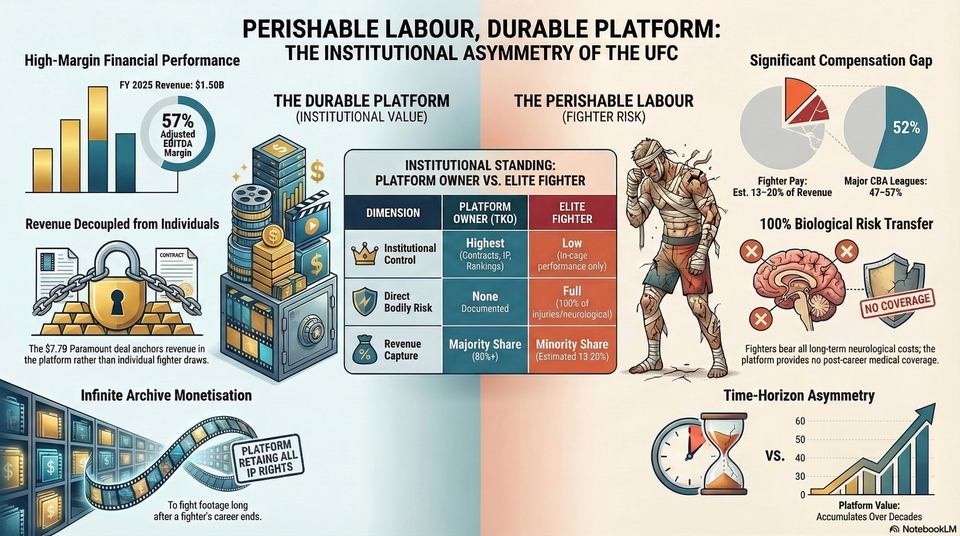
A new institutional analysis shows how UFC fighters generate a $1.5 billion business and sustain a $7.7 billion media machine, while absorbing the long-term neurological cost and leaving the archive behind for the platform to monetize forever.
For two decades, the UFC has sold a simple story: fighters take the risk, climb the ladder, and earn their reward on the biggest stage in combat sports.
A new institutional analysis argues that story is incomplete.
Perishable Labor, Durable Platform, released today as both a one-page executive brief and a full 10,000-word report, examines the UFC’s structure with unusual precision. It begins with the concession any honest analysis has to make: the platform built the distribution, the audience, the production engine, the sponsorship infrastructure, and the brand power that no individual fighter could have built alone.
Then it asks the harder question:
What does the structure reward, what does it extract, and who carries the cost once the lights are off?
The core asymmetry
The findings are difficult to ignore.
In FY 2025, UFC revenue reached $1.502 billion, with an adjusted EBITDA margin of 57%.
A new $7.7 billion domestic media rights deal with Paramount begins next year, locking in roughly $1.1 billion annually for seven years regardless of which specific fighters are on the roster.
Estimated fighter compensation levels drawn from the Le v. Zuffa antitrust litigation for the pre-2017 class period place the fighter share at roughly 13 to 20 percent of total revenue, well below the 47 to 57 percent labor shares common in the collectively bargained structures of the NBA, NFL, and MLB.
The platform also retains enduring control over fight footage, title history, and promotional archive value long after a fighter exits.
And the longest-tail cost of all, the neurological burden documented in the Cleveland Clinic Professional Athletes Brain Health Study, does not sit on TKO’s balance sheet. There is no pension. No guaranteed post-career medical coverage.
The fighter’s competitive window is biologically bounded.
The platform’s use of the resulting archive is not.
Five mechanisms that make the structure durable
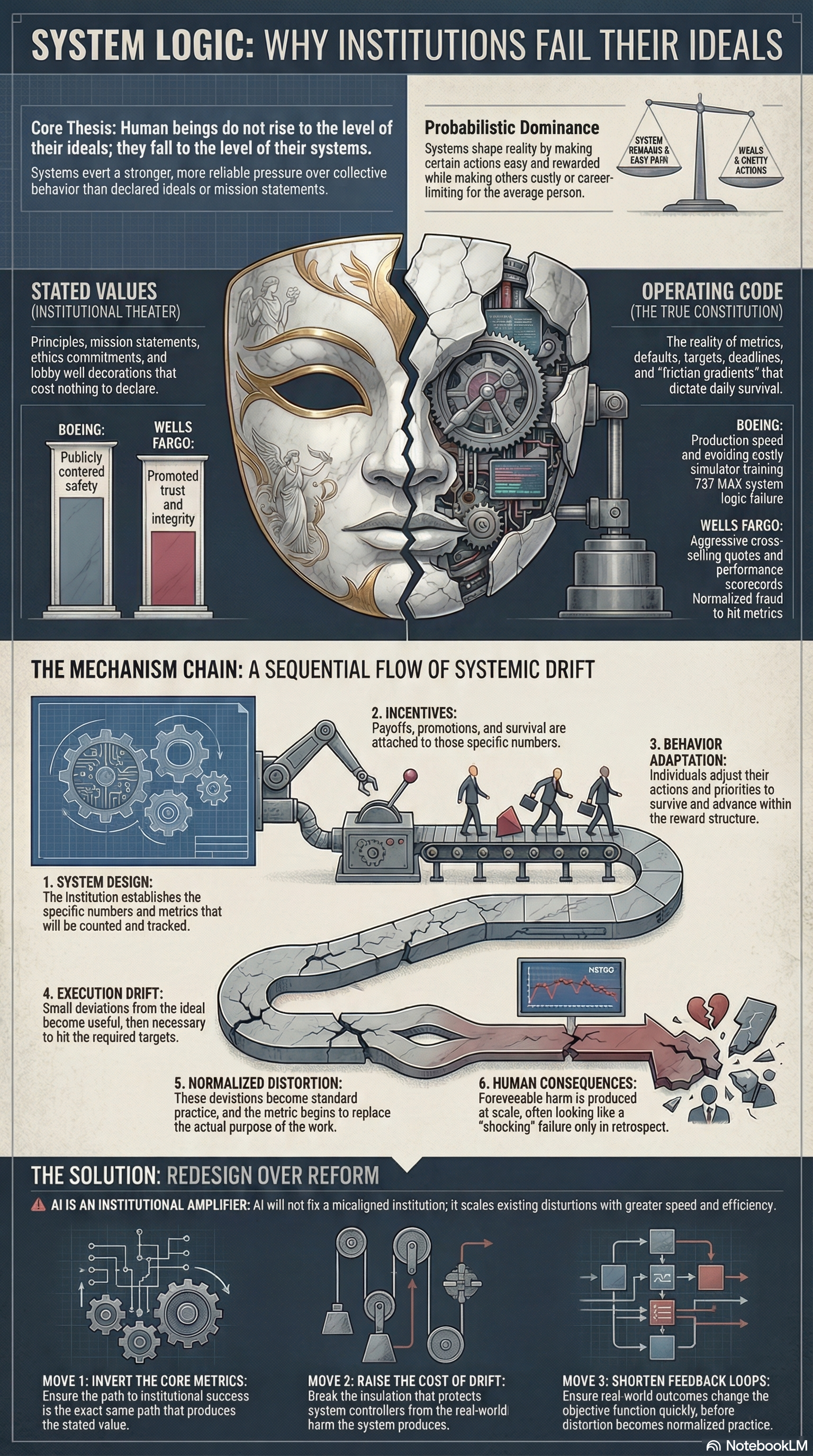
The report identifies five interlocking mechanisms that help explain why the model remains stable even when stars leave, champions fall, or public criticism spikes:
1. Substitution logic
No individual fighter is truly irreplaceable at the platform level. Names change. Events continue. Revenue persists.
2. Narrative stabilization
The promotion does not just sell fights. It controls framing, visibility, legitimacy, and the public storyline around ascent, conflict, and replacement.
3. Archive monetization
A fighter’s labor is time-limited. The platform’s ability to reuse, distribute, package, and profit from that labor is not.
4. Time-horizon asymmetry
The athlete’s earning window is short, fragile, and injury-bound. The enterprise operates on multi-year rights cycles, capital markets logic, and permanent content libraries.
5. Separated risk-and-revenue capture
The human being absorbs the acute and cumulative bodily risk. The institution captures the recurring media, licensing, and archive upside.
Taken together, these mechanisms describe a structure that does not depend on preserving any one fighter’s long-term welfare in order to preserve the platform’s long-term value.
A case study that clarifies the pattern
One of the report’s clearest case studies involves a contracted undisputed champion who exited under adversarial terms, secured larger external paydays, went 0-1 outside the UFC, and was released in March 2026.
The result is instructive.
His departure did not interrupt the platform’s commercial continuity. The footage remained valuable. The titles remained part of UFC history. The promotional archive remained intact. The platform’s ability to reuse, reference, and monetize the record of his labor continued without disruption.
The individual left.
The asset did not.
That is not a moral slogan. It is an institutional pattern.
What makes this analysis different
This is not a rage post. It is not a fighter grievance thread. It is not another recycled argument built on vibes, loyalty, or selective outrage.
It is a layered, source-cited institutional analysis built from audited SEC filings, court records, primary corporate announcements, and peer-reviewed neurological research through March 2026.
It is also careful.
Every analytical inference is marked with ↗.
The concession comes before the critique.
The report does not allege legal liability.
It does not prescribe a single mandatory policy solution.
It simply documents the pattern as clearly as possible and leaves the reader to confront what the structure appears to reward.
Why this matters
This matters to fighters, obviously. But it also matters to fans, investors, media people, sponsors, regulators, labor analysts, and anyone interested in how modern sports platforms convert human risk into durable enterprise value.
Because once you see the structure clearly, the conversation changes.
The debate is no longer trapped inside the usual stale slogans:
“they chose this,”
“that’s business,”
“only stars deserve more,”
“the UFC built the machine.”
The analysis already concedes that the machine was built.
The real question is what kind of machine it became.
Download the full-color PDFs below
You can read and share both versions here:
Companion Brief
A one-page executive summary for fast reading, posting, and circulation.
Full Report
The complete institutional analysis, including the actor matrix, control hierarchy, mechanisms, findings, and references.
Both PDFs preserve the original gold, deep-blue, and crimson design exactly as intended.
I’m publishing them here because the conversation around fighter economics has been loud for years and precise only in fragments. Now the data, structure, and argument are public in one place.
The record is open.
Read it. Test it. Argue with the evidence.
Member discussion