Regressive Leadership and the Escalation Loop
Look at what our systems can do now.
We have built machines capable of analyzing billions of data points, mapping global networks, predicting patterns, optimizing logistics, identifying anomalies, and accelerating decision-making at a speed no prior civilization could have imagined.
Now look at the people steering them.
That is the contradiction.
We are watching 21st-century tools of immense capability being directed by leadership classes that still operate on ancient instincts and outdated state logic. Protect what is mine. Fear what is outside. Build more force. Escalate faster. Justify later.
The technology changed.
The operating logic did not.
That is the escalation loop.
And in the age of AI, it is becoming a civilizational threat.
The loop is not broken. It has been upgraded.
Modern states still behave as if security is primarily achieved through secrecy, force, expansion, and narrative control. The slogans change depending on the era. National security. Democracy. Stability. Peace. Deterrence. The protection of national interests.
But the underlying mechanism remains the same.
Protect what is mine.
Fear what is outside.
Build more force.
Escalate faster.
Justify later.
That is the structure.
Once you see it, you cannot unsee it.
The problem is not simply that leaders make mistakes. The problem is that many of the institutions shaping global decisions are still trapped in a regressive logic that assumes more force, more control, and faster escalation are the default response to instability. Even when the tools become more advanced, the mindset remains primitive.
That is why so much of modern leadership feels simultaneously sophisticated and childish.
The systems are modern.
The instincts are ancient.
Restraint for the public. Escalation for the state.
One of the clearest signs of this failure is the double standard built into modern governance.
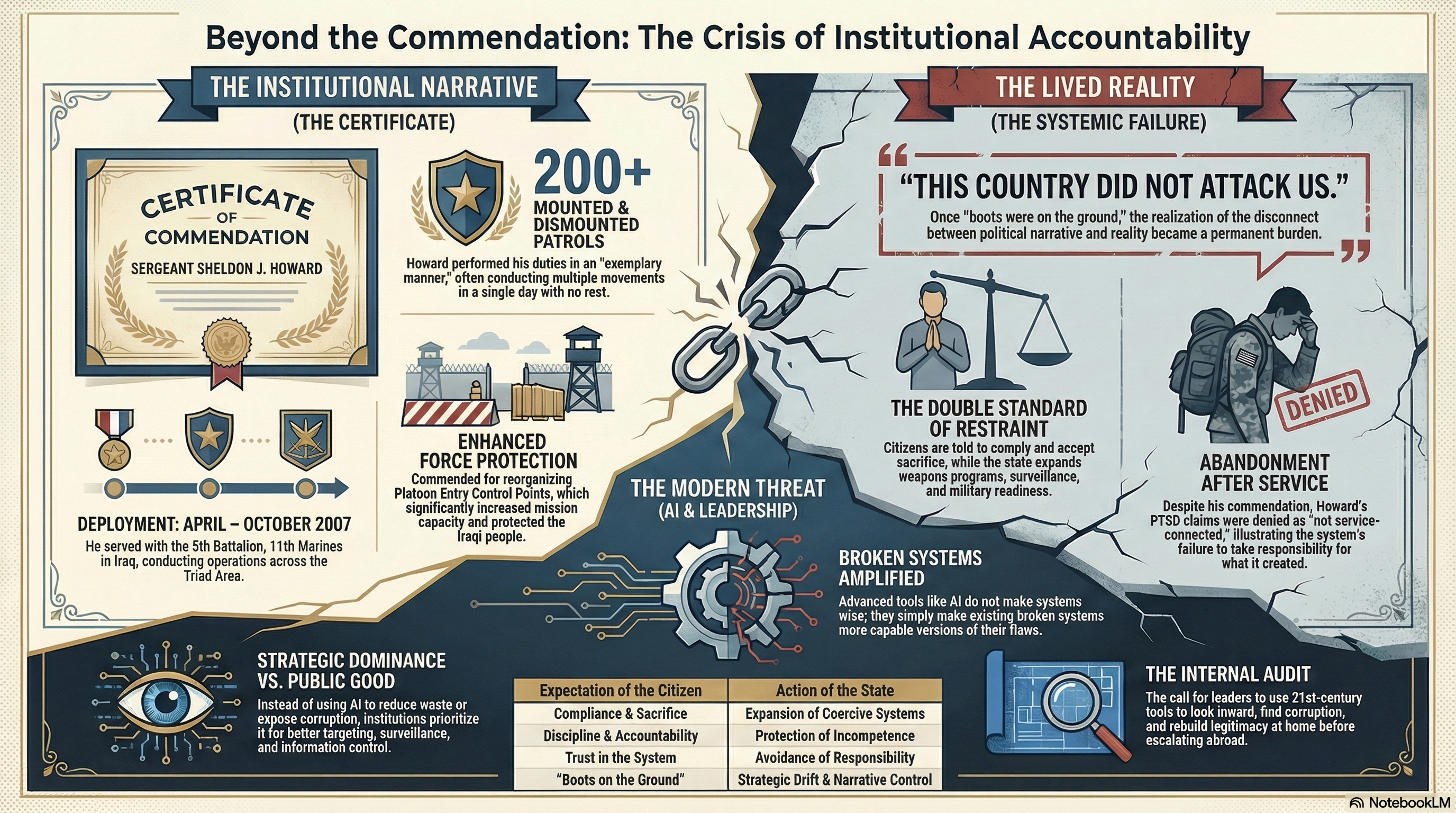
Ordinary people are told to comply, sacrifice, adapt, stay calm, obey the rules, and absorb the costs of instability with discipline.
If they make mistakes, the friction is immediate and unforgiving. The law responds. The economy punishes. The bureaucracy delays. The consequences land hard and fast.
But when states fail, the pattern is different.
There is no equivalent restraint.
There is no matching discipline.
There is no meaningful ceiling on expansion.
Governments continue building larger weapons systems, larger surveillance systems, larger intelligence architectures, and now larger AI-enabled systems of conflict. They demand austerity, patience, and compliance from the public while exempting themselves from the same logic of restraint they impose on everyone else.
That is the formula:
restraint for the public, escalation for the state.
And people feel it.
Even when they cannot express it in formal policy language, they know something is wrong. They know the burden of failure falls downward. They know the decision-makers making the largest bets are often the least exposed to the consequences. They know ordinary people are asked to live with the cost of wars, inflation, corruption, bureaucratic decay, and institutional dishonesty while the people steering the system remain insulated from the damage.
That instinct is not paranoia.
It is observation.
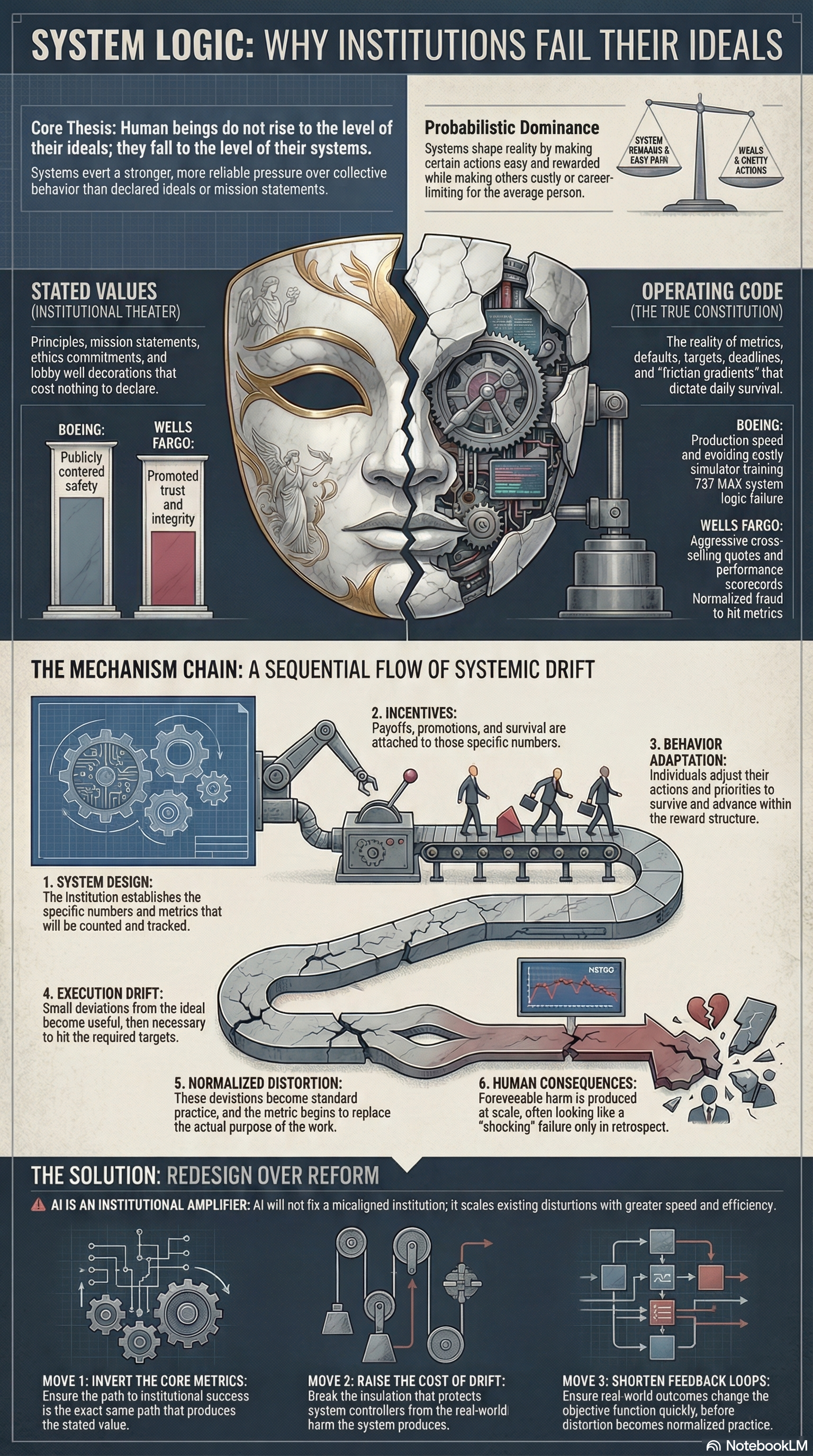
AI does not fix broken systems. It scales them.
AI could be used to do something truly useful.
It could help audit institutions.
It could expose corruption.
It could reduce bureaucratic waste.
It could improve decision quality.
It could strengthen accountability.
It could increase the speed and precision of internal reform.
That is the hopeful path.
But broken systems do not automatically choose the hopeful path.
They choose the path most aligned with what they already are.
And too often, what powerful institutions want from AI is not truth, accountability, or repair.
They want better targeting.
Better surveillance.
Better prediction.
Better control.
Better narrative management.
Better dominance.
That is the real danger.
AI does not automatically make systems wise.
It makes them more capable.
If the system is healthy, that capability can be used to improve public life.
If the system is corrupt, stagnant, dishonest, or detached from consequence, then AI becomes an amplifier of that condition. It does not cure the rot. It optimizes it.
That is what makes this moment so serious.
Humanity is increasing its technical capacity faster than its moral seriousness, institutional accountability, and leadership quality.
That is not progress.
That is acceleration without wisdom.
I am not speaking from the outside
I am not writing this as an academic observer or a man theorizing from safety.
I put boots on the ground.
I served inside the machine.
I believed in what I was told many Americans believed after 9/11. I believed that if my country had been attacked, a response had to follow. I believed service meant something real. I believed there was honor in going where the danger was. I believed there was meaning in standing between your people and those who would do them harm.
Then I got to Iraq.
And one of the first things I said to myself was simple:
this country did not attack us.
That realization changes the architecture of your mind.
Once boots are on the ground, the macro-political story collapses into local survival. The mission becomes immediate. Loyalty becomes local. The cost becomes personal. The slogans disappear. The body keeps the score. The institution back home continues writing its story while the people executing its policy are the ones absorbing the physical and psychological consequences.
That gap matters.
Because it reveals the difference between institutional narrative and lived reality.
The machine is eager to use people and reluctant to own the damage
When I came home, I did not come home untouched.
That should not surprise anyone.
Human beings are not built to carry prolonged hypervigilance, repeated exposure to danger, exhaustion, moral contradiction, and the constant possibility of death without consequence. Yet institutions routinely act as if they can push people to the edge of human tolerance and then treat the aftermath as administratively negotiable.
That is what happened to me.
When I sought help, my PTSD claim was denied as not service-connected. A German doctor disagreed.
That denial was not just a paperwork issue. It was a moral statement disguised as an administrative one.
It said, in effect: we can use your body, your nervous system, your time, your loyalty, and your risk when we need you, but when the consequences come home inside you, the institution may suddenly become uncertain, procedural, and evasive.
That is another form of leadership failure.
It is one thing to send men into the machine.
It is another thing to refuse responsibility when the machine comes home inside them.
And this is where many institutions reveal their ugliest habit: they isolate the witness.
They frame the person carrying the contradiction as unstable, bitter, broken, irrational, or dangerous. They pathologize the human response while protecting the structure that produced it.
I reject that framing.
I am not crazy because I see the contradiction.
I am not weak because I refuse to lie about what I lived through.
I am not dangerous because I believe failed leadership should be held accountable before it drags nations into catastrophe.
Before governments point outward, they should be forced to look inward
This is not a call for chaos.
It is a call for seriousness.
Before any government points outward, it should be forced to look inward.
Audit the institutions.
Find the corruption.
Find the waste.
Find the protected incompetence.
Find the officials violating public trust.
Find the people collecting paychecks while contributing nothing but stagnation, delay, and bureaucratic cover.
Find the systems that reward failure and punish truth-telling.
Remove them.
There should not be one standard of accountability for ordinary citizens and another for leaders, senior bureaucrats, defense contractors, and institutional managers. If institutions can demand discipline, sacrifice, and obedience from the public, then the public has every right to demand real accountability from institutions.
That is not extremism.
That is legitimacy.
The state should not be allowed to use external danger as a permanent excuse to avoid internal reform. In fact, the opposite is true: a government that refuses to clean house internally is already weakening itself externally. A corrupt, stagnant, dishonest institution does not become strong just because it buys better weapons or adopts better algorithms.
It becomes more dangerous.
Leadership is not sacred. It is conditional.
Too many people still treat leadership as if it deserves automatic deference.
It does not.
Leadership is not sacred.
It is conditional.
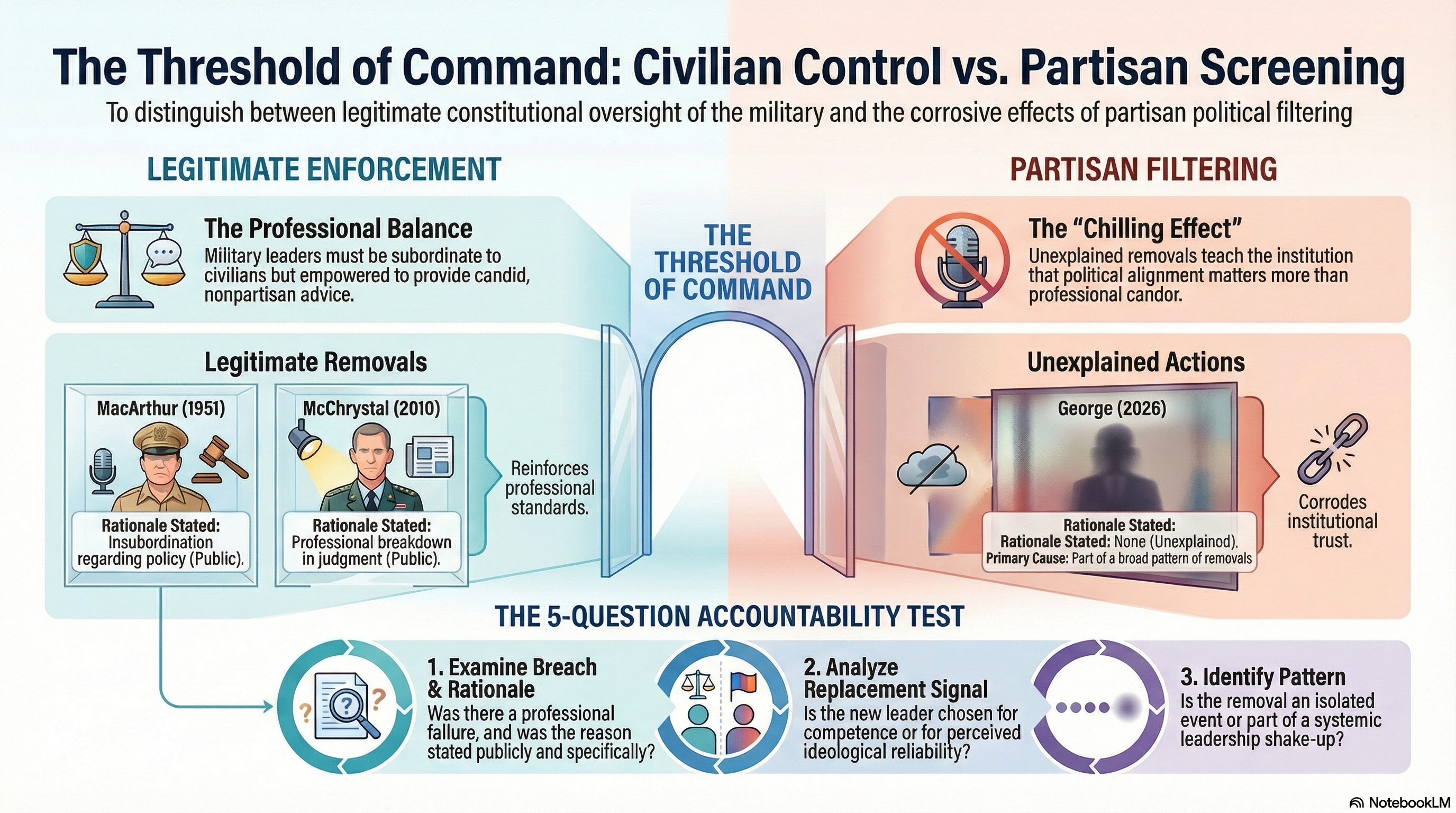
If leaders cannot reform institutions, reduce corruption, prevent reckless escalation, and use modern tools to serve the public rather than entrench themselves, then they do not deserve blind trust. They deserve scrutiny. They deserve challenge. And when they continue failing at civilizational scale, they deserve replacement.
That is not instability.
That is civic adulthood.
The real instability comes from allowing outdated, insulated, compromised leadership classes to continue making civilization-level decisions with increasingly powerful tools while remaining shielded from consequence.
That is how collapse gets normalized.
That is how drift becomes doctrine.
That is how broken systems keep reproducing themselves.
Moral clarity is not the threat
One of the most manipulative tactics failing systems use is to mislabel moral clarity as instability.
If you tell the truth too directly, you are called emotional.
If you point to contradiction, you are called bitter.
If you demand accountability, you are called dangerous.
If you refuse to participate in the lie, you are framed as the problem.
But the people warning that the house is on fire are not the real danger.
The real danger is the people still controlling the building.
That is the truth at the center of all this.
Not every critic is correct. Not every act of outrage is wisdom. But a civilization that automatically treats disciplined truth-telling as a threat while treating institutional fraud as leadership is already deep in decline.
I do not want more anger in the world.
I want less fraud.
I do not want stronger machines serving weaker men.
I do not want future generations inheriting AI systems more powerful than the moral courage of the people directing them.
I want internal reform before external escalation.
I want accountability before catastrophe.
I want leaders who can look inward before they point outward.
And I want people to stop confusing the witness with the wound.
Because the real danger is not only the enemy outside the gate.
It is also the regressive leadership inside the walls.

Member discussion