
The Danger of Unexplained Military Firings
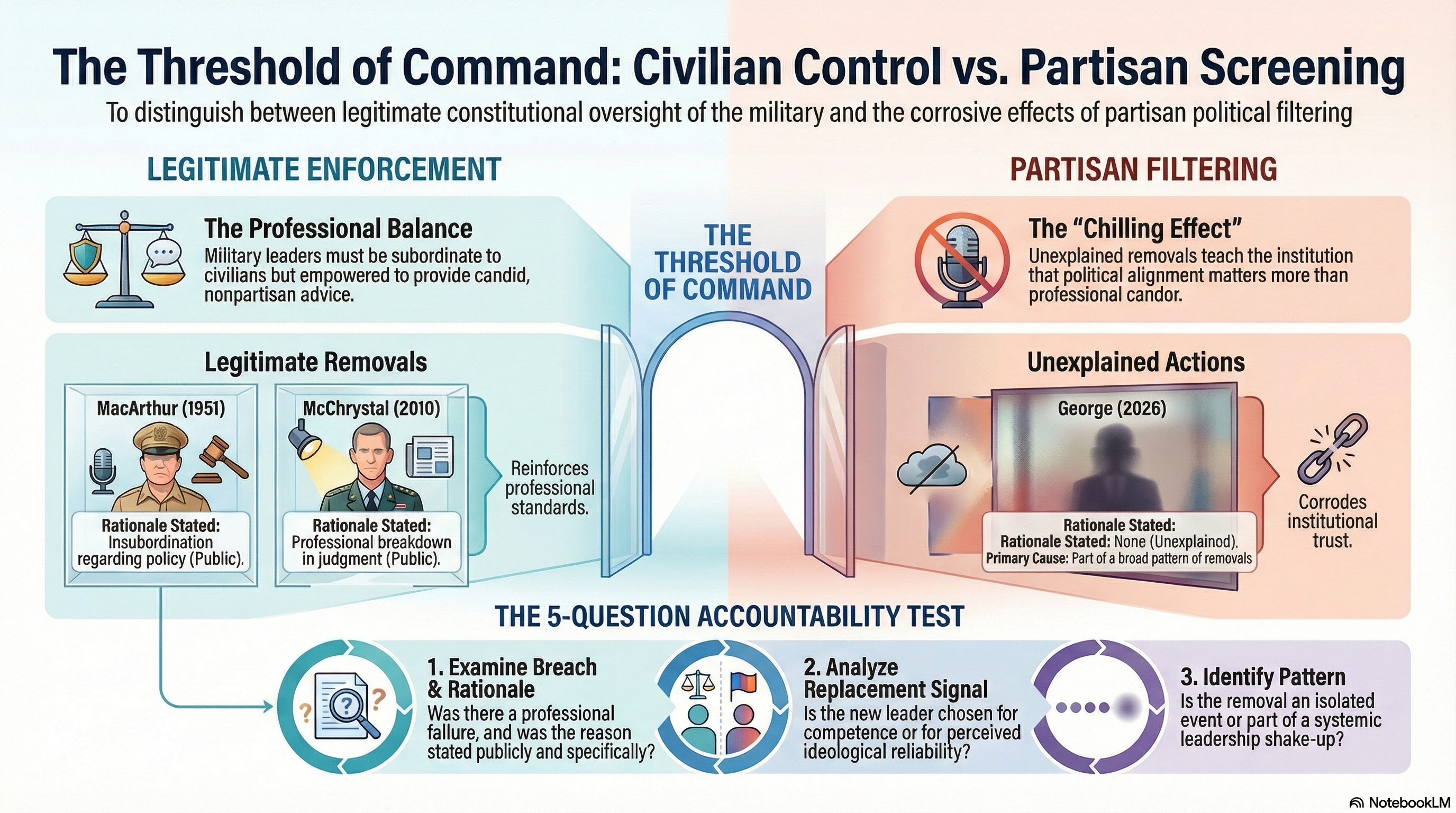
The danger is not civilian control itself. Civilian control is necessary. It is constitutional. It is the baseline condition of American civil-military relations.
The danger begins when lawful civilian authority stops functioning as a mechanism for directing policy and enforcing standards and starts functioning as a filter for political and ideological reliability.
That is where the real institutional risk lives.
The American military is not designed to be independent of civilian authority. It is designed to be subordinate to elected leadership while remaining professionally nonpartisan. That balance is not decorative. It is the whole architecture. It is what allows the system to maintain both democratic control and professional military judgment at the same time.
Once that balance starts to shift, the damage is rarely announced in dramatic terms. Institutions almost never confess what they are becoming while they are becoming it. The warning signs show up earlier, and one of the clearest is unexplained senior-level removals.
The issue is not whether civilians can remove generals. They can. Presidents and defense secretaries have broad authority over military leadership. The issue is what repeated unexplained removals teach the institution about what kinds of leaders are safe to become, what kinds of honesty are dangerous, and what kinds of advice are survivable.
That is why unexplained military firings matter.
Civilian control is necessary. Partisan filtering is something else.
Too much public discussion collapses legality and legitimacy into the same category. A removal is lawful, so people assume it is healthy. A firing is within formal authority, so they assume it carries no deeper institutional significance.
That is lazy analysis.
Something can be lawful and still be corrosive. Something can be constitutional in form and degrading in effect.
Civilian leaders are supposed to set policy. Military leaders are supposed to obey lawful orders. But that is only half the system. The other half is the professional ethic that makes military advice worth having in the first place.
A functioning officer corps is not supposed to tell elected officials only what they want to hear. It is supposed to provide candid, competent, and politically unowned judgment. That is what makes civilian control useful instead of theatrical. If every senior officer learns that career survival depends on ideological safety, then civilian control still exists on paper while professional candor begins to collapse in practice.
That is the danger. Not independence from civilian leadership. Not military veto power. The danger is political ownership.
The professional ethic is the hidden stabilizer
The military profession depends on something more than obedience. It depends on a nonpartisan ethic that keeps the institution tied to the constitutional order rather than to a faction inside it.
That ethic is easy to praise and easy to damage.
It survives only if officers believe they can still tell civilian leaders things those leaders do not want to hear. It survives only if professional judgment is protected more than ideological comfort. It survives only if truth remains safer than flattery.
Once that changes, the system does not need to become openly partisan to become politically bent. It only needs to teach enough people, at enough levels, that candor carries career risk.
That kind of lesson rarely arrives through a formal memo. It arrives through signals.
What legitimate enforcement looks like
Not every firing is politicization. Some firings are exactly what civilian control is supposed to look like.
Harry Truman’s removal of Douglas MacArthur is the benchmark case. MacArthur had crossed the line from military advice into public and operational defiance. The rationale was visible. The breach was legible. The constitutional principle was clear. A general does not set national policy over the elected commander in chief.
The McChrystal case followed a similar institutional logic. The issue was not ideological misalignment. The issue was professional breakdown, contempt toward civilian leadership, and the collapse of command trust. The strategy remained in place. The removal enforced standards rather than partisan loyalty.
That distinction matters because it gives us a standard.
Legitimate enforcement has recognizable features:
the breach is visible,
the rationale is stated,
the institutional logic is clear,
and the action reinforces professional norms rather than ideological conformity.
When those conditions exist, civilian control is not under threat. It is being exercised properly.
Why unexplained firings are different
Unexplained removals belong to a different category because the institution is forced to infer the lesson.
When a senior leader is removed and no public breach has been made visible, the remaining force begins asking its own questions:
What actually caused this?
What behavior is no longer safe?
What kind of disagreement is now career-ending?
What kind of alignment is being rewarded?
If that happens once, the institution may absorb it as an isolated event.
If it happens repeatedly, the institution begins adapting.
That adaptation is the real story.
Unexplained removals do not just change personnel. They change incentives. They narrow the zone of acceptable candor. They make advice safer, flatter, and more politically calibrated. They train ambitious officers to read preferences before they read reality. They teach commanders that protecting a career may require managing tone, substance, and truth in ways that have nothing to do with military merit.
That is how a profession bends before doctrine changes.
Personnel decisions are signals
Senior removals are not just personnel actions. They are institutional signals.
They tell people what gets rewarded.
They tell people what gets punished.
They tell people what kind of officer is worth becoming.
That signaling effect is often more important than the administrative act itself.
A removal for clear professional failure tells the force that standards still matter.
A removal without explanation, especially in a visible pattern, tells the force something else: that survival may depend on political safety as much as professional competence.
Once that lesson takes hold, the culture shifts quietly. Candor becomes selective. Risk reporting becomes more politically aware. Hard truths get softened before they move up the chain. Advice is shaped not only by battlefield reality or strategic judgment, but by institutional self-protection.
Serious systems are not always degraded by dramatic corruption. Often they are worn down by repeated signals that teach everyone what survival requires.
The five-question test
If you want to distinguish legitimate civilian enforcement from partisan screening, ask five questions.
Was the officer removed for insubordination, misconduct, strategic failure, or some other identifiable professional breach?
Was the rationale stated publicly and specifically?
Does the replacement appear chosen for competence and stewardship, or for ideological reliability?
Is the action isolated, or part of a broader pattern?
Will the signal encourage candid military advice, or narrow it?
That is the test.
It does not eliminate uncertainty. It does not answer motive with magical precision. But it does force the right analysis.
It shifts the conversation away from “Can civilians do this?” and toward the more serious question: “What is this teaching the institution?”
That is where the real stakes are.
The real issue
The real issue is not whether civilians are in charge. They are. They are supposed to be.
The real issue is what kind of military their methods are producing.
Personnel decisions shape more than rosters. They shape the conditions under which truth can travel upward. They shape whether commanders learn to privilege reality or preference. They shape whether the officer corps remains a source of candid professional judgment or becomes a structure that quietly selects for political survivability.
That is why unexplained military firings matter.
They matter not because every unexplained firing proves partisan capture. It does not.
They matter because repeated unexplained firings teach the institution to ask a different question than “What is true?”
They teach it to ask, “What is safe?”
And once that becomes the governing question inside a military profession, the damage has already begun.
Reuters, April 2, 2026: US Army chief of staff fired by Hegseth, sources say
Truman Library: Statement and Order by the President on Relieving General MacArthur of His Commands
Army University Press: Instilling the Nonpartisan Ethic at the Unit Level
Obama White House Archives, June 23, 2010: President Obama on Afghanistan, General McChrystal & General Petraeus

Member discussion