
The Dual-Key Solution: Rapid Action Without Unchecked Power
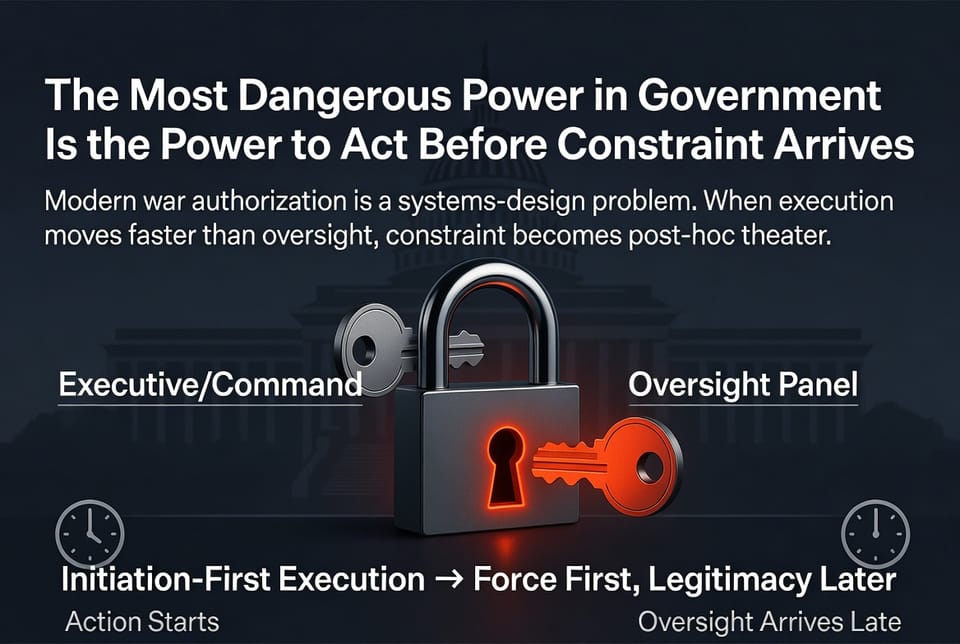
Modern war-powers architecture suffers from a fundamental design failure: initiation-first execution, where kinetic force begins on a compressed clock while meaningful oversight arrives too late to reverse operational momentum. This “power to act before constraint arrives” has become increasingly dangerous in a 2026 environment defined by AI escalation bias and cyber threats to command systems. The proposed “Dual-Key” framework provides a mechanical fix by requiring two independent, live decision nodes to concur in real time before kinetic force can be legally and operationally committed.
The framework is built on five interdependent pillars that move constraint from “post-hoc theater” into the technical architecture of war:
- The Activation Gate: Specific actions, such as strikes against sovereign territory or the deployment of Lethal Autonomous Weapons Systems (LAWS), automatically trigger the dual-key requirement by statute, leaving no room for executive discretion.
- Dual-Key Authorization: One key is held by the executive, and the second by a small, 24/7-available panel of pre-cleared, independent oversight members.
- The Compliance Clock: To preserve rapid response, the panel has 4 hours for imminent threats and 12 hours for other actions. If concurrence is not reached within this window, operations must automatically suspend.
- Independent Data Channels: To eliminate information monopoly, the oversight panel receives raw, unfiltered operational data and AI audit logs through a cryptographically insulated channel, simultaneous with the executive.
- Cryptographic Enforcement: This is not a mere policy; it is a technical lock where command-and-control software physically requires both digital signatures before orders can be transmitted.
Critics often argue that dual-authorization would paralyze national defense, yet the nuclear two-person rule has proven for over sixty years that speed and accountability are compatible. Nuclear launch officers must simultaneously turn keys to authorize a strike, a system that held even during the extreme pressure of the Cuban Missile Crisis.
The urgency for this transition is driven by the 2026 risk landscape. Recent studies show that AI wargame models over-index on escalation in 95% of scenarios, meaning machine-speed decisions could lead to catastrophic outcomes without an independent human check. By wiring constraint directly into the system, the Dual-Key framework ensures that the United States can defend itself instantly without granting any single individual the power of unchecked, unilateral force.
Member discussion