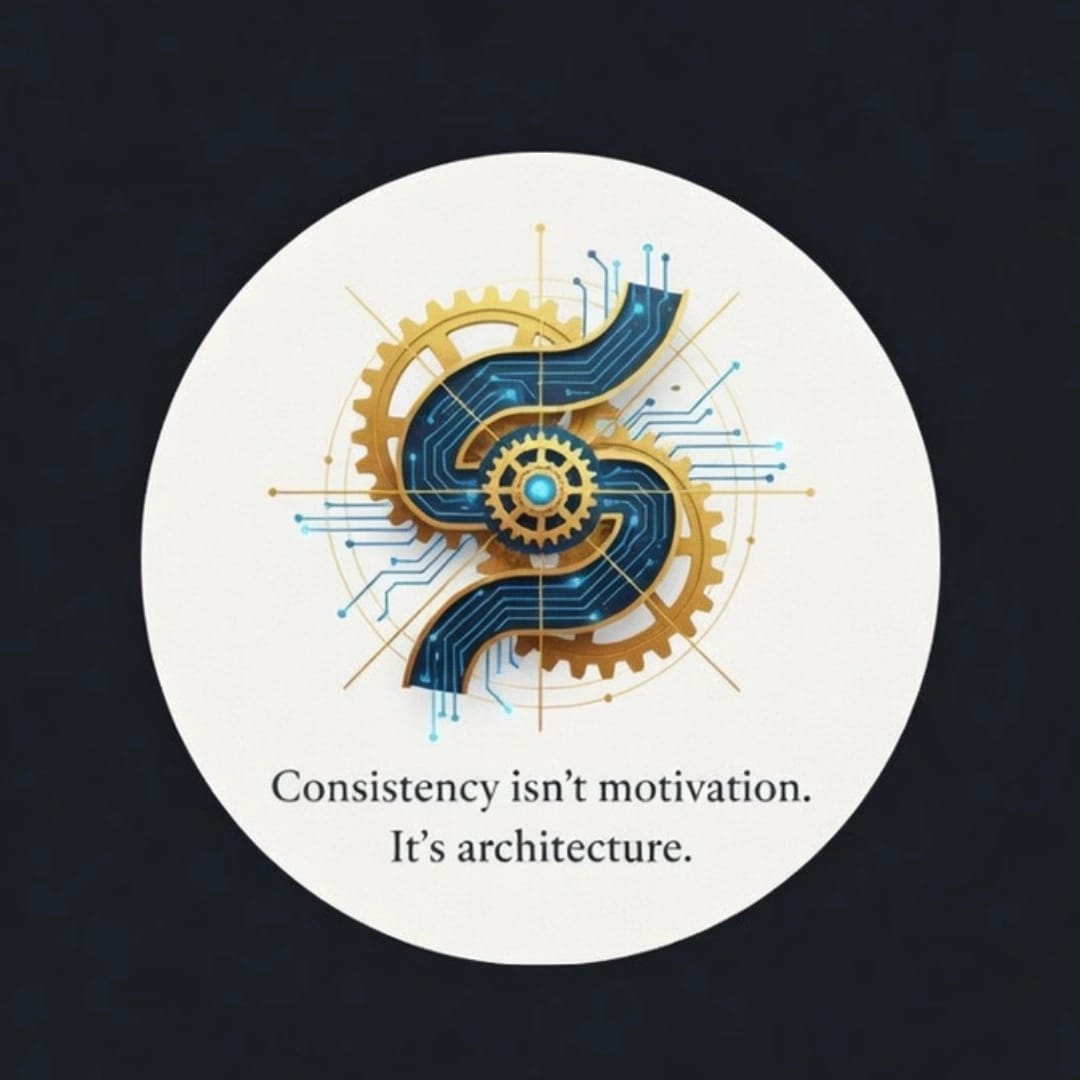
The Personal AI Operating System
Building Cognitive Infrastructure for Research in the Age of Machine Intelligence
AI is no longer scarce.
Attention is.
Coherence is.
Memory is.
Most knowledge work is becoming less about finding answers and more about building systems that can hold context, track reasoning, and convert ideas into durable intellectual assets.
Without an architecture, AI simply accelerates fragmentation.
The Problem: AI Everywhere, Architecture Nowhere
We are living through an explosion of AI capability.
Researchers, founders, analysts, and writers now have access to:
- large language models
- transcription tools
- summarization systems
- research copilots
- knowledge databases
- AI agents
- automation frameworks
The result should be an unprecedented expansion of human cognitive capability.
Instead, most people experience something very different.
Ideas appear and disappear.
Prompts get refined, but thinking remains scattered.
Research turns into a pile of transcripts, notes, bookmarks, and chat histories.
Insights get published without traceable reasoning.
And a week later, the entire process starts again.
The problem is not a lack of intelligence.
The problem is the absence of cognitive infrastructure.
From AI Tools to Cognitive Infrastructure
Most people treat AI as a tool.
A Personal AI Operating System (PAIOS) treats AI as infrastructure.
Instead of asking:
“What can this model do for me right now?”
The question becomes:
“How do I build a system that continuously converts thinking into durable knowledge?”
In this model, AI is not a chatbot.
It becomes part of an architecture that supports the full lifecycle of thinking.
A Personal AI Operating System coordinates:
- information capture
- context preservation
- reasoning support
- synthesis
- publication
The goal is not just to produce answers.
The goal is to produce assets.
The Architecture of a Personal AI Operating System
At a minimum, a Personal AI Operating System contains five core layers.
1. Input Layer — Capturing Raw Thought
This layer captures the raw material of thinking.
Examples include:
- voice recordings
- meeting transcripts
- research notes
- screenshots and documents
- quick prompts and reflections
The goal is simple: nothing valuable disappears.
2. Memory Layer — Persistent Knowledge
Most AI systems forget.
A Personal AI OS does not.
This layer stores:
- research archives
- structured notes
- concept libraries
- references and sources
Instead of isolated conversations, the system builds a growing knowledge base.
3. Processing Layer — AI Reasoning
This is where modern models become powerful.
AI systems assist with:
- summarization
- pattern extraction
- argument construction
- literature comparison
- draft generation
The system transforms raw inputs into structured insights.
4. Synthesis Layer — Turning Ideas into Artifacts
Thinking only becomes valuable when it produces something durable.
In this layer, ideas become:
- research papers
- essays and articles
- frameworks
- diagrams
- books
The system converts knowledge into publishable artifacts.
5. Publication Layer — Intellectual Distribution
The final layer distributes ideas into the world.
Typical outputs include:
- Medium essays
- LinkedIn research posts
- academic papers
- GitHub repositories
- newsletters
At this stage, the system has transformed thinking into public intellectual infrastructure.
Why Cognitive Infrastructure Matters
Throughout history, major intellectual shifts were accompanied by new information systems.
Printing presses changed scholarship.
Libraries changed science.
The internet changed research.
AI is about to change thinking itself.
But this transformation will not be driven by the models alone.
It will be driven by architectures that organize cognition.
The individuals and institutions that build these architectures will have a decisive advantage.
Not because they are smarter.
But because their thinking compounds.
From Individual Workflows to Cognitive Systems
The transition from tools to systems mirrors earlier technological shifts.
Early computing involved isolated programs.
Modern computing relies on operating systems.
AI is entering the same stage.
We are moving from:
AI tools → AI systems
And eventually toward:
cognitive infrastructure.
A Personal AI Operating System is one possible model for how individuals can begin constructing that infrastructure today.
The Emerging Discipline of Cognitive Architecture
As AI becomes embedded in research, writing, and analysis, a new field may emerge.
Call it:
Cognitive Infrastructure Design.
Or:
Personal Knowledge Systems Engineering.
Or simply:
thinking about thinking at system scale.
The important idea is not the terminology.
The important idea is that the architecture of thinking is becoming a design problem.
And the people who learn to design these systems will shape the next era of intellectual production.
The Future of Research Is Architectural
For centuries, intellectual work has focused primarily on ideas.
In the coming decade, the structure of thinking itself will become just as important.
The most powerful thinkers will not simply generate insights.
They will build systems that:
capture ideas,
connect knowledge,
support reasoning,
and produce enduring work.
In other words:
they will operate their thinking the way engineers operate complex systems.
They will build Personal AI Operating Systems.
TL;DR
AI is not just a tool for answering questions.
It can become the infrastructure that supports thinking itself.
A Personal AI Operating System (PAIOS) organizes AI tools into a coherent architecture that captures ideas, preserves knowledge, supports reasoning, and produces intellectual artifacts.
The future of knowledge work will belong to those who design systems for thinking, not just those who generate ideas within them.
Further Reading
- Vannevar Bush — As We May Think (1945)
Early vision of knowledge augmentation and associative information systems. - Douglas Engelbart — Augmenting Human Intellect (1962)
Foundational work on human-computer systems for expanding cognitive capability. - Licklider, J.C.R. — Man-Computer Symbiosis (1960)
One of the earliest articulations of collaborative human-machine intelligence. - Michael Nielsen — Reinventing Discovery (2011)
Explores how digital tools reshape scientific thinking and collaboration. - Andy Matuschak & Michael Nielsen — How Can We Develop Transformative Tools for Thought?
A modern exploration of knowledge systems and cognitive tools.
Author
S. Howard
Researcher exploring cognitive infrastructure, AI-assisted knowledge systems, and institutional systems engineering.
Member discussion