
The Threshold of Command
The American military is not meant to be independent of civilian authority. It is meant to be subordinate to elected leadership while remaining professionally nonpartisan. That balance is the whole architecture. It is what keeps the armed forces inside the constitutional order without reducing them to a faction’s enforcement arm.
The danger begins when lawful civilian control stops functioning as a mechanism for directing policy and enforcing standards and starts functioning as a filter for political and ideological reliability.
That is the threshold of command.
The issue is not whether civilians can remove generals. They can. The issue is what kind of institution those removals are shaping, what kind of incentives they establish, and what kind of advice they teach the force to produce. Once personnel decisions begin signaling that political safety matters as much as professional candor, the officer corps starts learning the wrong lesson long before anyone says so out loud.
That is why the April 2026 removal of Army Chief of Staff Gen. Randy George matters.
On its face, the case can be framed as a lawful personnel decision. But viewed institutionally, it raises a harder question. If a four-star officer is removed abruptly, with more than a year left in his term, with no visible public breach and no public rationale, what does the rest of the force conclude? Not about the law. About survival.
Control versus filtering
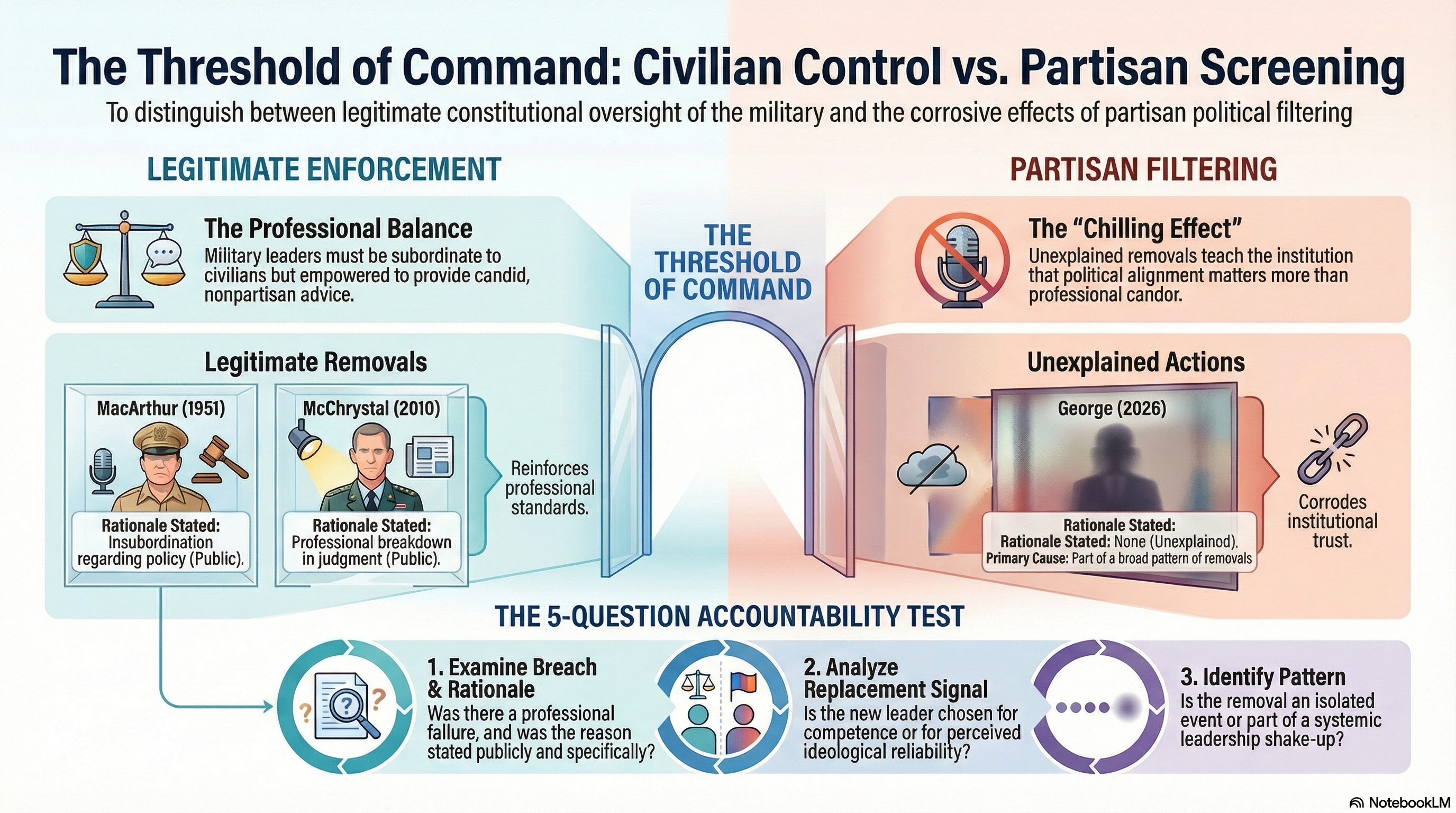
Civilian control is a constitutional necessity. Partisan filtering is something else.
That distinction is the entire argument.
In any serious civil-military system, elected officials must control policy. The military does not get veto power over war aims, force posture, or national strategy. That is the constitutional line. But the system only works if the officer corps remains professionally nonpartisan and capable of giving unvarnished advice regardless of who holds office.
Once that second half begins to erode, the military does not need to become openly partisan to become politically bent. It only needs to learn that ideological alignment, or at least ideological safety, is increasingly important to advancement and retention.
That shift is subtle. It often arrives wrapped in legality. It can happen through formal authority exercised in ways that are constitutional in form and corrosive in effect.
Something can be lawful and still be corrosive.
That is the point too many people miss. A power can be real and still be misused institutionally. A firing can be permissible and still send a damaging signal through the force.
What legitimate enforcement looks like
Not every firing is politicization. Some are exactly what healthy civilian control requires.
The first benchmark is Douglas MacArthur. Truman removed him in 1951 after public and operational conflict over Korea policy. The institutional logic was legible. The breach was visible. MacArthur had moved beyond military advice and into public defiance of national policy. That is the kind of case that reinforces the constitutional order. The signal is clear: generals do not set national strategy over elected civilians.
The second benchmark is Stanley McChrystal. Obama accepted his resignation in 2010 after the Rolling Stone profile exposed contemptuous behavior toward civilian leadership inside McChrystal’s circle. Again, the rationale was visible. The professional breach was legible. The signal was not about ideology. It was about discipline, trust, and the non-negotiable requirements of command. Strategic continuity remained intact. The institution learned that professionalism mattered more than personality.
Both cases matter because they show what legitimate enforcement looks like:
a visible breach,
a stated rationale,
and an institutional logic tied to standards rather than partisan loyalty.
Those are not minor details. They are the difference between enforcement and filtering.
Why George is a threshold case
The George case is different because no comparable breach has been made visible.
That does not prove partisan screening as a settled fact. Serious analysis has to be better than that. But it does place the case in a different category.
MacArthur was public defiance.
McChrystal was professional breakdown.
George, at least on the public record, is a threshold question.
The problem is not just opacity. The problem is what opacity does inside a hierarchy.
When a senior leader is removed without a visible professional rationale, the institution fills in the gap for itself. Officers start asking what behavior is unsafe, what advice is unwelcome, what kind of friction is now career-ending, and what kind of leader is safe to become. If the answer is no longer competence and candor but political calibration, then the system begins to drift.
That drift does not need a formal doctrine update. It does not need a speech declaring a new era. It happens through signals.
Personnel decisions are signals
Senior removals are not just personnel actions. They are institutional signals.
They tell the force what gets rewarded.
They tell the force what gets punished.
They tell the force what kind of honesty is survivable.
They tell the force what kind of officer is worth becoming.
That is why unexplained patterns matter more than one-off drama. A single firing can be interpreted as an isolated decision. A sustained pattern of abrupt removals, especially without public rationale, starts to reshape behavior. It teaches the profession that truth must be politically calibrated. It teaches commanders to think not only about battlefield reality, but about the preferences of those above them. It teaches risk reporting to become safer, flatter, and more protective.
That is how institutions bend before doctrine changes.
The danger is not only that civilian authority becomes aggressive. The danger is that the officer corps begins adapting its behavior in anticipation of that authority. The profession becomes more deferential, more selective in what it says, and more attentive to political mood than professional duty. That is not open partisanship. It is often worse because it is quieter.
The five-question test
To distinguish between legitimate civilian enforcement and partisan filtering, five questions matter.
Was the officer removed for an identifiable professional breach such as insubordination, misconduct, or strategic failure?
Was the rationale stated publicly and specifically?
Does the replacement appear chosen for competence, or for ideological reliability?
Is the action isolated, or part of a broader pattern?
Will the signal encourage candid military advice, or narrow it?
That is the real framework.
By that standard, MacArthur and McChrystal remain benchmark cases of legitimate enforcement. Their breaches were visible. Their rationales were public. Their institutional logic reinforced standards.
George does not yet fit that category. Not because his removal was unlawful. Not because any one unexplained firing automatically proves a purge. But because the case lacks the features that make legitimate enforcement legible to the institution.
That is what makes it a threshold case.
The real question
The real issue is not whether civilians are in charge. They are supposed to be.
The real issue is what kind of military their methods are producing.
If personnel decisions reinforce standards, civilian control is strengthened.
If personnel decisions reward political safety over professional candor, civilian control begins to hollow out the very profession it depends on.
A military that fears telling civilian leaders uncomfortable truths is not a stronger instrument of democratic control. It is a weaker instrument of national defense.
That is the deeper institutional cost of unexplained leadership removals.
By the time an officer corps is willing to admit it has become politically bent, the lesson was usually learned much earlier, in the quiet adaptation of careers, incentives, and survival instincts.
That is the threshold of command.
Member discussion