
Why UFC Fighters Get Paid Less Than You Think
Why UFC Fighters Get Paid Less Than You Think (And Why It’s Not an Accident)
**Body:**
A fighter signs a contract that looks, to most people, like real money.
$10,000 to show. $10,000 to win.
Camp is self-funded. Coaches, gym fees, travel, nutrition, recovery. Lower-end camp costs typically fall in the $4,000 to $8,000 range. Add taxes. Add the manager cut. If the fighter loses, the check is the show money, and the expenses do not care.
The injury risk does not care either. There is no employer health insurance. No guaranteed schedule. No obligation to offer another fight.
Then the event happens.
Broadcast rights. Gate. Sponsorship. Pay-per-view.
The total revenue moves.
The fighter’s pay does not.
That gap is the point. Not a morality story. A system design.
**The System**
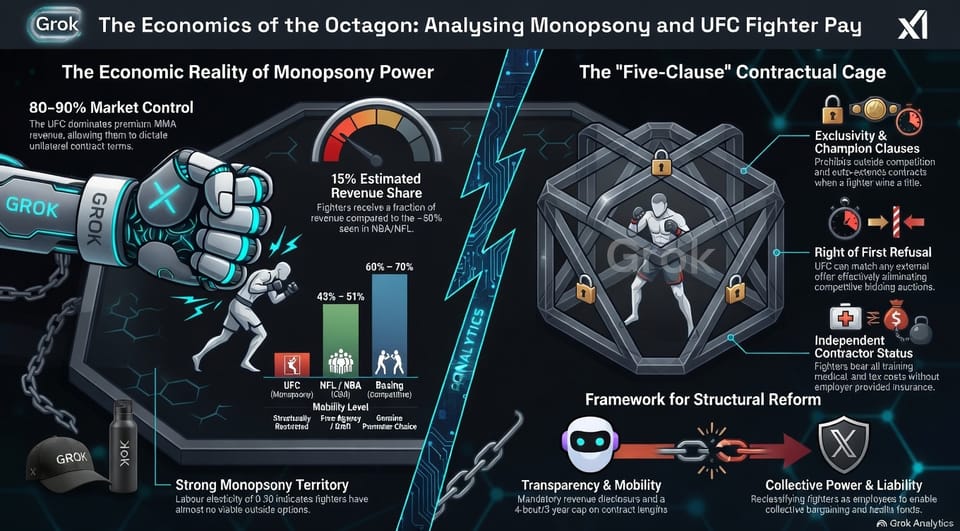
The UFC operates in a position that matters more than any individual negotiation.
It is the dominant buyer of elite MMA labor and the dominant seller of premium MMA events.
That combination changes everything.
On one side, fighters are trying to sell their labor.
On the other, the organization controls access to the platform that gives that labor value.
When one side has limited alternatives and the other does not, negotiation stops being symmetrical.
Fighters are paid primarily through fixed purses.
Revenue is pooled at the promotion level.
Only a small group of elite fighters participate in upside.
Everyone else works on fixed terms.
**The Mechanism**
The core mechanism is simple: fixed labor cost vs. variable revenue.
Fighters are paid show money + win bonus + discretionary bonuses — all set before the event.
Revenue is realized after PPV performance, gate outcomes, and sponsorship value.
Fighters, in most cases, are not connected to that upside. The promoter is.
This outcome does not require coordination. It emerges from structure.
**Why Fighters Can’t Just “Walk Away”**
A fixed-pay system only becomes suppressive when workers cannot force competition.
The contract structure reduces that ability:
- Exclusivity limits outside options
- Champion clauses extend control at peak value
- Matching rights discourage competing bids
- Injury tolling preserves control during inactivity
- Independent contractor status isolates bargaining
Each piece reduces mobility. Together, they reduce it enough that saying “no” is not credible.
**The Proof (Boxing)**
This isn’t about risk. It isn’t about individual negotiation skill. It’s about structure.
Look at boxing. Same type of sport. Same independent contractors. No union. But multiple promoters competing for talent.
Result: headline fighters take home 60–70% of event revenue (often cited range for major bouts, though not uniform across all fighters).
The difference isn’t the risk. It isn’t the rules. It’s one buyer versus many. One buyer sets the price. Many buyers create an auction.
**The Settlement**
Fighters sued. $375 million settlement. Approved February 2025. Zero contract changes. Zero revenue floor. The architecture survived the largest antitrust challenge in combat sports history — completely intact.
**Final Line**
A fighter’s pay is not low because the UFC gets away with it.
It is low because the system is built so the fighter cannot force an auction.
---
**Tags:** #UFC #MMA #SportsBusiness #LaborEconomics #Monopsony #FighterPay
Member discussion