AI Leverage Without Losing Your Judgment: The Orchestrator’s Guide
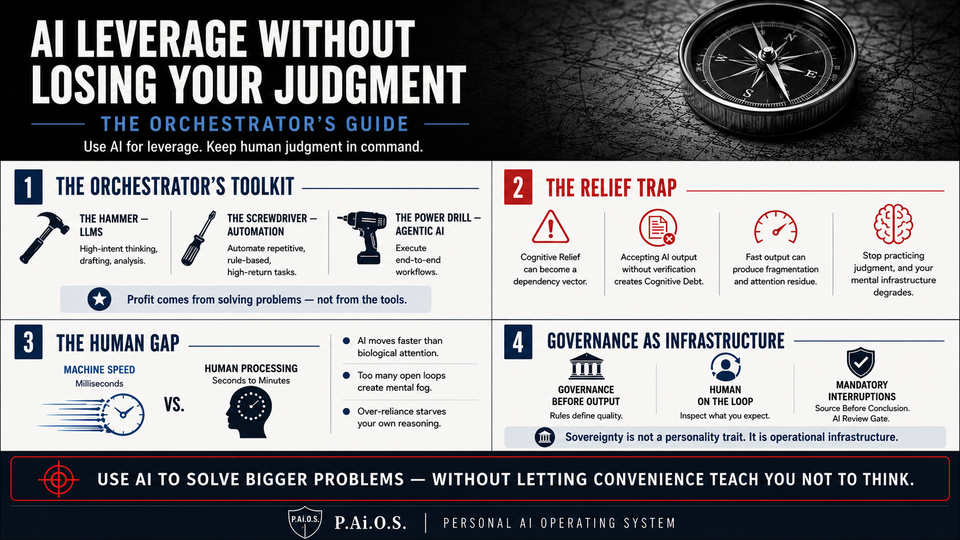
In the modern professional landscape, we are faced with a paradox: machines demand a level of consistency that the biological human brain cannot naturally sustain. As a result, we turn to AI for leverage, but in the process, we risk falling into the "Relief Trap"—outsourcing our most valuable asset: our judgment.To truly thrive, you must move beyond being a mere tool-user and become an Orchestrator. An Orchestrator is someone who owns a powerful toolkit but governs it with a "Human on the Loop" philosophy to ensure cognitive sovereignty.Part 1: Building the Orchestrator’s ToolkitProfit does not come from the tools themselves; it comes from solving problems. The Orchestrator uses a three-part toolkit to gain massive leverage:
- The Hammer (LLMs): Tools like ChatGPT or Claude are for manual, high-intent tasks. To use the hammer effectively, apply the MAPS framework: define the Mission, provide a specific Ask, set the Parameters, and define the output Shape.
- The Screwdriver (Automation): For tasks that are Repetitive, Rule-based, and offer a high Return (The Rule of R), use automation platforms like Zapier or Make. This is where you "set it and forget it" to buy back your time.
- The Power Drill (Agentic AI): Agents handle entire end-to-end workflows. Instead of just doing a step, they execute a complete process, like validating a product or recruiting a team.
Part 2: The Hidden Risk of "Cognitive Relief"While these tools offer immediate relief from an infinite inbox, that relief is a dependency vector. When we skim an AI summary or accept a draft without verification, we incur "Cognitive Debt".
- The Human Gap: The disparity between AI’s speed and our processing capacity leads to fragmentation and attention residue—the "mental fog" that remains when we switch between too many open loops.
- The Deconditioning Effect: If we stop practicing the "expensive" internal habits of reasoning and verification, our mental infrastructure degrades. Eventually, we may find ourselves unable to reconstruct our own reasoning without re-consuming AI output.
Part 3: Governance as Operational InfrastructureThe successful Orchestrator treats cognitive sovereignty—the ability to think independently—not as a personal virtue, but as operational infrastructure. This is achieved through deliberate protocols:
- Governance Before Output: The quality of your system is defined by the rules governing it, not just the speed of its production.
- Human on the Loop: Even with Agentic AI, the human must remain "on the loop" to inspect what they expect. This prevents "context rot," where an AI’s performance degrades over long tasks.
- Mandatory Interruptions: Use protocols like "Source Before Conclusion" or the "AI Review Gate". These force you to ask: "Am I accepting this just because it reduces my cognitive effort?".
The future belongs to those who use the toolkit to solve the biggest problems, while protecting their ability to think before convenience teaches them not to
#P.Ai.O.S #PersonalAIOperatingSystem #AILeverage #AIOrchestration #AIGovernance #HumanJudgment #CognitiveSovereignty #DecisionIntelligence #SystemsThinking #AIWorkflow #Automation #AgenticAI #HumanInTheLoop #GovernanceBeforeOutput #CognitiveDebt #TheHumanGap #OperationalClarity #Leadership #Military #Accountability #MoralCourage #Power #Authority #Reform #SpeakTruth #InstitutionalFailure #MessageToHumanity #RegulatedPresence
AI Leverage Without Losing Your Judgment: The Orchestrator’s Guide
Member discussion