The Laboratory Phase: Why Small Audiences Matter More Than Viral Reach
Most people misunderstand the early stage of building.
They think small numbers mean small value.
Six subscribers.
Ten readers.
Twenty listeners.
No algorithmic explosion.
No blue-check validation.
No flood of dopamine metrics convincing the nervous system it has “made it.”
But the early phase is not the failure phase.
It is the laboratory phase.
And laboratories matter because this is where systems either become coherent or collapse under their own contradictions before scale ever arrives.
Right now, most of the internet is optimized backward.
People scale noise before they establish architecture.
They chase reach before clarity.
Output before governance.
Attention before substance.
Then they wonder why everything becomes shallow, fragmented, emotionally unstable, and impossible to maintain once pressure arrives.
The result is a digital ecosystem filled with:
- creators burning out,
- audiences drowning in content,
- institutions optimizing perception instead of truth,
- and AI systems amplifying unregulated cognition at industrial scale.
Humanity built infinite publishing capability before building widespread cognitive discipline.
An absolutely fascinating species-level decision.
The Real Advantage Is Not Volume
The next era of advantage will not belong to the people who generate the most content.
AI already solved abundance.
The bottleneck now is:
- filtration,
- judgment,
- regulation,
- synthesis,
- governance,
- and clarity under pressure.
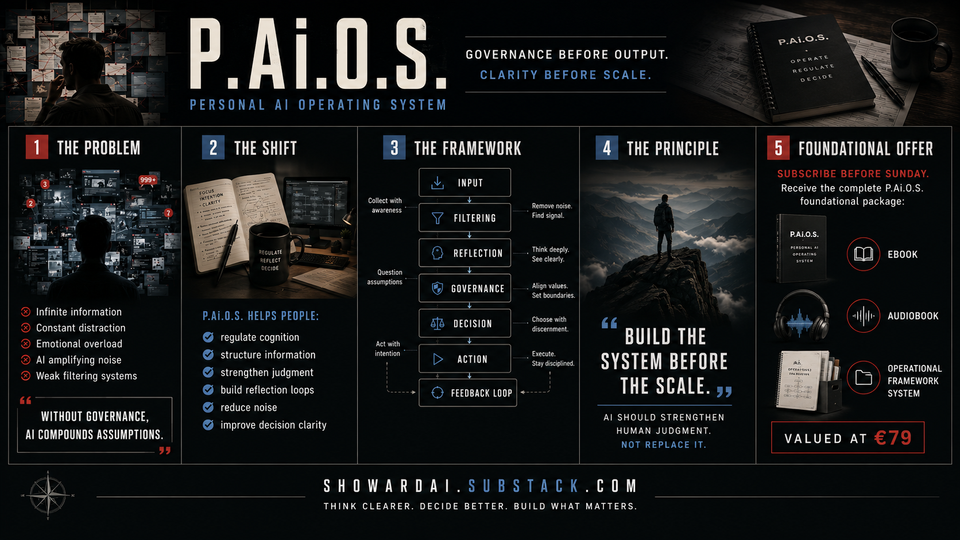
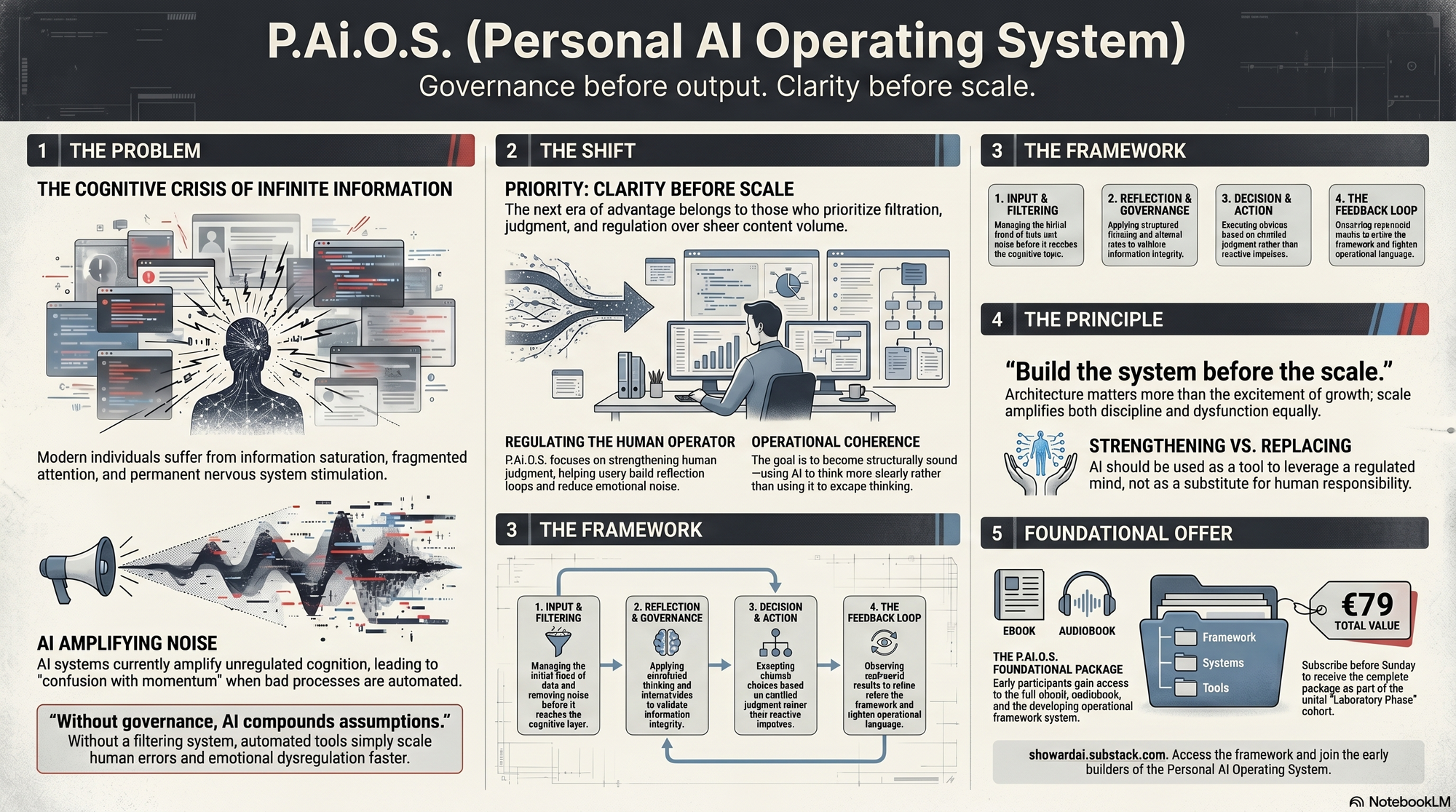
That is the core thesis behind P.Ai.O.S.
The Personal AI Operating System.
Not AI as entertainment.
Not AI as dependency.
Not AI as a replacement for human judgment.
AI as a structured cognitive environment designed to strengthen human decision-making instead of eroding it.
Because without governance, AI does not compound intelligence.
It compounds assumptions.
And assumptions scale fast.
A weak thought repeated by automation becomes confusion with momentum.
A bad process amplified by AI becomes institutionalized dysfunction.
An emotionally dysregulated operator with advanced tools simply creates faster chaos.
This is why governance matters more than generation.
Why the Small Phase Matters
Right now, I only have a handful of subscribers.
That does not bother me.
Because the current objective is not mass adoption.
The objective is refinement.
The people entering now are not just “followers.”
They are early participants inside a live system test.
That changes the relationship entirely.
The process now is:
- observe feedback,
- refine frameworks,
- tighten language,
- identify confusion points,
- improve onboarding,
- strengthen structure,
- test emotional resonance,
- validate usefulness in real life.
This is how serious systems are built.
Not by shouting into the void until an algorithm randomly rewards visibility.
But by developing operational coherence before scale arrives.
People often romanticize virality.
Virality without architecture is usually just collapse scheduled for later.
The Cognitive Crisis Nobody Wants to Name
The deeper issue is not AI itself.
The deeper issue is that modern people are cognitively overloaded and emotionally fragmented before AI even enters the equation.
Most individuals are operating under:
- constant information saturation,
- fragmented attention,
- emotional exhaustion,
- institutional distrust,
- algorithmic manipulation,
- social comparison loops,
- economic pressure,
- and permanent nervous system stimulation.
Then AI arrives and multiplies throughput.
But throughput is not wisdom.
Acceleration is not clarity.
And intelligence without regulation becomes dangerous surprisingly fast.
At both the personal and institutional level, the same principle keeps appearing:
Systems fail when feedback loops disappear.
That applies to governments.
Corporations.
Media ecosystems.
Military systems.
Relationships.
And individual cognition.
P.Ai.O.S. exists because most people do not need more information.
They need:
- structured thinking,
- reflection loops,
- operational clarity,
- emotional regulation,
- source integrity,
- and disciplined interaction with intelligent systems.
The future belongs to people who can remain coherent while surrounded by noise.
The Early Builders
There is something important about the people who enter early.
Early participants are different from mass audiences.
They tolerate iteration.
They observe development.
They contribute to refinement.
They become part of the architecture itself.
That creates stronger systems because the feedback arrives while change is still possible.
Large institutions often fail because scale hardens dysfunction before correction mechanisms activate.
By the time the system realizes it is broken, the bureaucracy protecting the brokenness has already become stronger than the truth itself.
Small systems still have maneuverability.
That is an advantage.
The goal is not to stay small forever.
The goal is to become structurally sound before growth compounds weaknesses.
Because scale amplifies everything:
- intelligence,
- confusion,
- discipline,
- dysfunction,
- coherence,
- and delusion.
The architecture always matters more than the excitement surrounding it.
The Human Layer
At the center of all this is still a human problem.
Not a software problem.
Not a platform problem.
A human regulation problem.
Technology keeps increasing leverage.
But leverage magnifies whatever is already present inside the operator.
A regulated mind becomes more capable.
An impulsive mind becomes more dangerous.
An exhausted mind becomes easier to manipulate.
An undisciplined institution becomes unstable faster.
This is why responsibility cannot disappear simply because automation improves.
Busywork should go.
Human responsibility should not.
That distinction may become one of the defining survival questions of the AI era.
Because eventually the world will divide into two categories:
- people using AI to escape thinking,
- and people using AI to think more clearly.
Those are not the same civilization.
The Invitation
This Sunday is the close of the first foundational subscriber phase.
Anyone who subscribes before the end of Sunday will receive the complete P.Ai.O.S. foundational package, including:
- the full ebook,
- the audiobook,
- and the developing operational framework system package currently valued at €79.
Not because the system is “finished.”
Because the people entering now are helping shape what it becomes.
This is not mass-market productivity theater.
It is an evolving cognitive and operational framework built around:
- governance before output,
- clarity before speed,
- regulation before reaction,
- and disciplined interaction with AI systems.
The early phase matters.
So do the people willing to build during it.
#AI #Leadership #Governance #SystemsThinking #ArtificialIntelligence #DecisionMaking #PAIOS #RegulatedPresence
Member discussion