Beyond the Model: Why AI Success Lives or Dies Upstream
Most AI conversations are obsessed with the visible layer.
Which model is faster?
Which model reasons better?
Which one can replace which job?
Which tool has the newest feature?
Those questions matter, but they are not the real center of gravity.
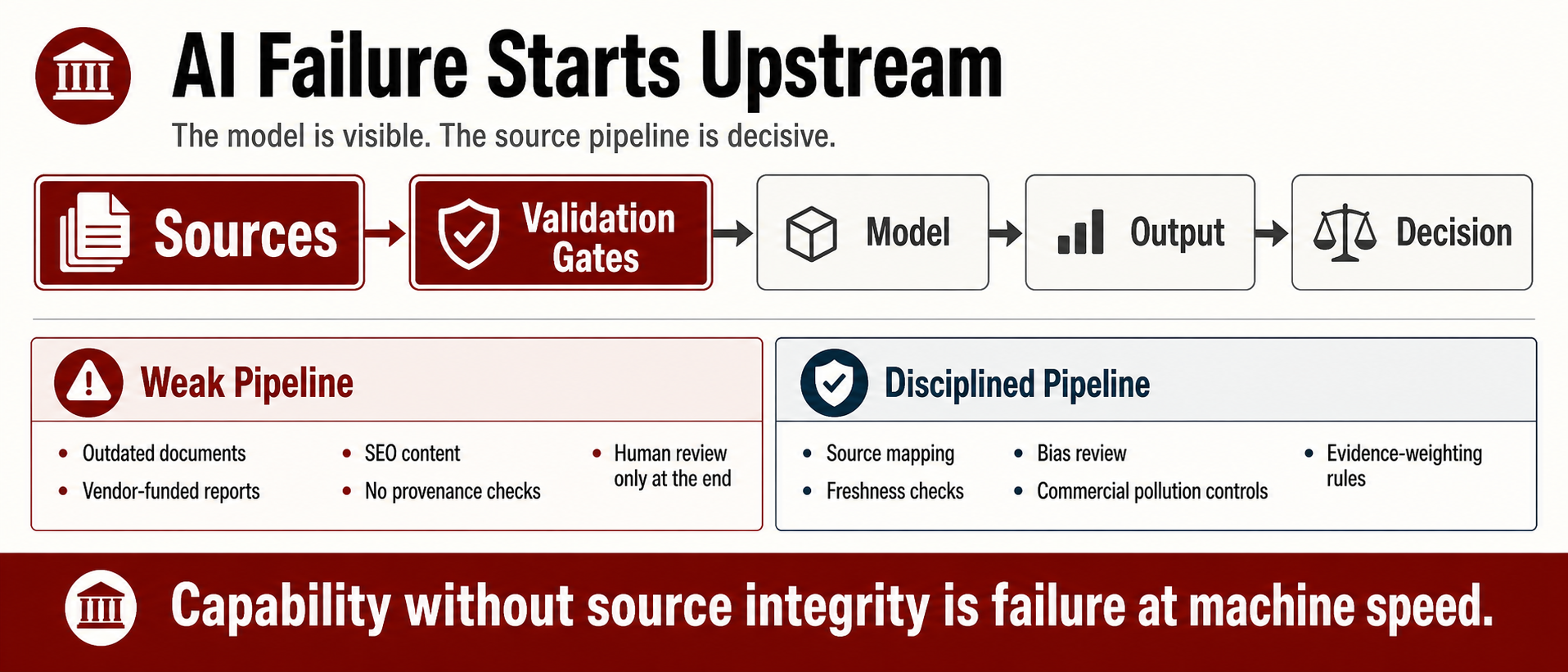
The model is only the final expression of a much larger system. By the time an AI produces an answer, the most important decisions have already been made upstream: what sources were admitted, what documents were trusted, what incentives shaped the evidence, what was excluded, and what the system was allowed to treat as knowledge.
That is where the real risk lives.
If the source layer is biased, outdated, incomplete, or commercially polluted, the model does not magically correct it. It scales it. AI does not remove weak evidence from the organization. It industrializes it.
Bad assumptions become structured.
Thin evidence becomes fluent.
Outdated information becomes operational.
Vendor narratives become “analysis.”
Search-optimized garbage becomes institutional memory.
That is not intelligence.
That is acceleration without discipline.
The Illusion of Intelligence
One of the most dangerous failure modes in AI systems is evidence laundering.
This happens when a system flattens very different kinds of material into one confident answer. A peer-reviewed study, a vendor-funded white paper, an outdated internal memo, a sales page, and a search-optimized blog post can all enter the same pipeline and emerge as if they carry equal weight.
The output sounds coherent.
That is the trap.
Fluency creates the illusion of judgment. But fluency is not verification. A polished answer can still be built on polluted inputs.
This is especially dangerous in organizations that already have weak evidence discipline. AI does not fix those habits. It inherits them. Then it accelerates them.
If an organization rewards speed over verification, the AI will learn the same operating logic. If leadership treats documentation as a formality, the system will convert poor documentation into confident answers. If no one owns the source pipeline, no one truly owns the outcome.
Commercial Pollution Is Not Neutral
A major upstream risk is commercial pollution.
Not all bad information looks false. Some of it looks professional, cited, polished, and persuasive. Vendor-funded reports, SEO content, sponsored narratives, market-positioning material, and recycled thought leadership can tilt the information environment without being obviously wrong.
That is what makes it dangerous.
The system may not hallucinate. It may accurately summarize corrupted terrain.
That distinction matters.
A model can faithfully process a polluted source environment and still produce a harmful result. The failure is not always inside the model. Often, the failure is in what the organization allowed into the system in the first place.
Governance Starts Before the Prompt
Real AI governance is not a slide deck. It is not a policy memo sitting in a shared folder like some ceremonial artifact from the Temple of Compliance.
Governance is operational.
It means defining what counts as admissible evidence. It means mapping source provenance. It means checking freshness, ownership, incentives, uncertainty, and contradiction before information reaches the model.
The question is not only, “Did a human review the output?”
That is late-stage inspection.
The better question is, “What controls existed before the output became possible?”
Human-in-the-loop systems often provide the appearance of control while leaving the real decision frame untouched. If the source set is already narrowed, biased, or polluted, the reviewer is not governing the system. They are inspecting the final symptom.
Real control happens upstream.
The Operating System Around the Model
The organizations that succeed with AI will not simply be the ones that buy the most powerful tools. They will be the ones that build operating systems around those tools.
That means source integrity.
Evidence mapping.
Validation gates.
Clear ownership.
Freshness checks.
Bias detection.
Commercial contamination controls.
Uncertainty labeling.
Escalation paths when evidence conflicts.
Without that structure, AI becomes a confidence machine attached to whatever institutional habits already exist.
If those habits are disciplined, AI can scale judgment.
If those habits are weak, AI will scale failure with better language.
The future of AI governance will not be decided only by model capability. It will be decided by whether organizations can build systems worthy of trust before they ask machines to act intelligently.
Capability without source integrity is not intelligence.
It is failure at machine speed.
#AI #ArtificialIntelligence #AIGovernance #ResponsibleAI #DataGovernance #SourceIntegrity #EvidenceMapping #KnowledgeManagement #DecisionIntelligence #SystemsThinking #OperationalExcellence #RiskManagement #Leadership #Accountability #DigitalTransformation #InstitutionalFailure #MessageToHumanity #RegulatedPresence
Help a Marine Stay in the Fight.
Member discussion