
Trump and Epstein: What the Public Disclosure Record Actually Shows
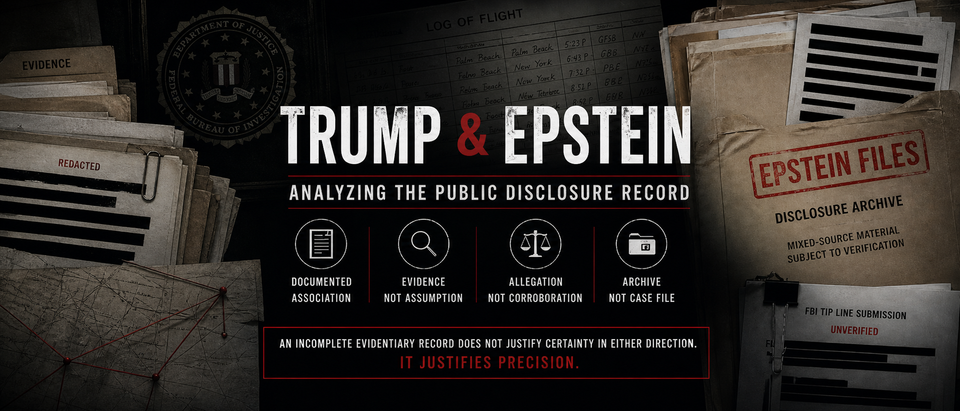
The public record regarding Donald Trump and Jeffrey Epstein presents a complicated evidentiary picture.
That complexity usually gets destroyed in public commentary.
One side treats every archive mention as proof of criminal implication. The other side treats the absence of charges as proof that there is nothing meaningful to examine. Both readings fail for the same reason: they collapse different evidentiary categories into one convenient conclusion.
A disciplined reading of the record requires holding two facts at the same time.
First, there was a documented social and logistical association between Donald Trump and Jeffrey Epstein during the 1990s. That association is real, historically significant, and not in serious factual dispute.
Second, the publicly reported primary material reviewed in the archive does not establish Trump’s participation in Jeffrey Epstein’s criminal enterprise.
The distance between those two points is where most public analysis fails.
The Epstein Files Are Not a Curated Case File
The Epstein file releases should not be read as a clean prosecutorial case file.
They are better understood as a disclosure archive: a mass release of mixed-source material with uneven levels of verification.
That distinction matters.
A case file is organized around evidentiary relevance, legal theory, investigative findings, and prosecutorial standards. A disclosure archive is much noisier. It can contain duplicated records, unvetted public submissions, press clippings, contact books, investigative fragments, and materials pulled from multiple filing systems.
That means name frequency can be misleading.
A person appearing many times in an archive does not automatically mean that person is implicated in criminal conduct. One event can generate multiple document entries. One name can appear across indexes, lists, duplicate files, address books, and secondary material.
Volume is not proof.
It may simply be structure.
The Five Categories People Collapse
To read the archive correctly, names must be separated into distinct evidentiary categories:
Mentioned.
Associated.
Alleged against.
Corroborated.
Legally implicated.
Those are not the same thing.
Being mentioned in a contact book is not the same as being corroborated in a crime. Appearing in flight records is not the same as being legally implicated. Being the subject of an unverified claim is not the same as having that claim independently established.
This is the central interpretive failure around the Epstein files.
People collapse the categories because collapse is easier than analysis. It also performs better online, which tells you everything you need to know about the moral incentives of the attention economy.
What the Record Supports
The record supports a bounded but significant social and logistical association between Trump and Epstein during the 1990s.
The first category is flight records. Reporting on logs from the Maxwell case and DOJ releases place Trump on Epstein’s aircraft at least seven to eight times between 1993 and 1997. These routes were primarily between Palm Beach and New York.
The second category is contact records. Epstein’s personal address book contained fourteen phone numbers connected to Trump, including contacts for Mar-a-Lago. That documents access and social proximity. It does not, by itself, document participation in specific conduct.
The third category is social proximity. Trump and Epstein moved in overlapping New York and Palm Beach circles. Trump has acknowledged knowing Epstein, and has stated that the association ended in the mid-2000s after a falling out. The primary materials reviewed do not independently establish the precise circumstances of that break.
So the association is real.
But association alone does not establish criminal participation.
What the Allegations Require
The archive does contain allegations, but allegations have to be tiered by reliability.
Corroboration means independent verification through a second primary source, documentary evidence, or investigative confirmation. It does not mean the same claim appearing repeatedly in the same noisy archive.
That distinction is essential.
The lowest-reliability tier includes anonymous third-party claims and public FBI submissions. The Department of Justice warned that this material may include fake, falsely submitted, untrue, and sensationalist claims. Regarding Trump specifically, certain claims in this tier were characterized by the DOJ as unfounded and false.
One item in the record is a 2019 FBI interview summary in which a former Palm Beach Police Chief described a 2006 phone call where Trump allegedly said “everyone knew” about Epstein’s conduct. But the DOJ stated that it was not aware of corroborating evidence that this call to law enforcement actually took place twenty years ago.
That is not a trivial detail.
The presence of a claim inside a federal archive does not automatically make the claim tested evidence.
What the Record Does Not Establish
The record also has limits.
No flight-log evidence has been cited placing Trump on routes to Little St. James Island.
No publicly reported primary material in the archive establishes Trump’s participation in Epstein’s trafficking activity.
Independent reviews by The Washington Post and Reuters found no public evidence in the releases of inappropriate behavior by Trump related to Epstein.
No charges have been filed against Trump in connection with Epstein’s crimes.
That final point has to be handled carefully. The absence of charges is the current legal posture. It is not proof of factual innocence. It is also not irrelevant. It simply reflects what has and has not been prosecuted.
Precision matters here because both overstatement and understatement distort the record.
Why Public Interpretation Fails
The biggest failure is frequency as corroboration.
A high mention count can look like significance, but in a disclosure archive, frequency may be an artifact of duplication, indexing, and document structure.
The second failure is association as implication.
A flight manifest, address book entry, or social connection may establish proximity. It does not automatically establish criminal conduct.
The third failure is treating unverified submissions as testimony.
A public tip-line submission is not the same as sworn testimony. It is not the same as documentary corroboration. It is not the same as a charging document.
The fourth failure is overcertainty.
Some people treat the lack of charges as proof that nothing meaningful exists. Others treat the volume of mentions as proof of guilt. Both approaches turn an incomplete disclosure archive into something it is not: a validated case file.
That is not analysis.
That is narrative selection.
Final Takeaway
A disciplined reading of the record supports four claims.
Trump appears frequently in the archive.
There was a real social and logistical association between Trump and Epstein during the 1990s.
The specific allegations against Trump remain in the unverified and uncorroborated tier.
The public record reviewed does not establish participation in Epstein’s criminal enterprise.
An incomplete evidentiary record does not justify certainty in either direction.
It justifies precision.
#EpsteinFiles #TrumpEpstein #PublicRecord #EvidenceMatters #ForensicAnalysis #Accountability #SystemsThinking #InstitutionalFailure #Power #Authority #LegalAnalysis #MediaLiteracy #MessageToHumanity #RegulatedPresence

Help a Marine Veteran Stay in the Fight.


Member discussion