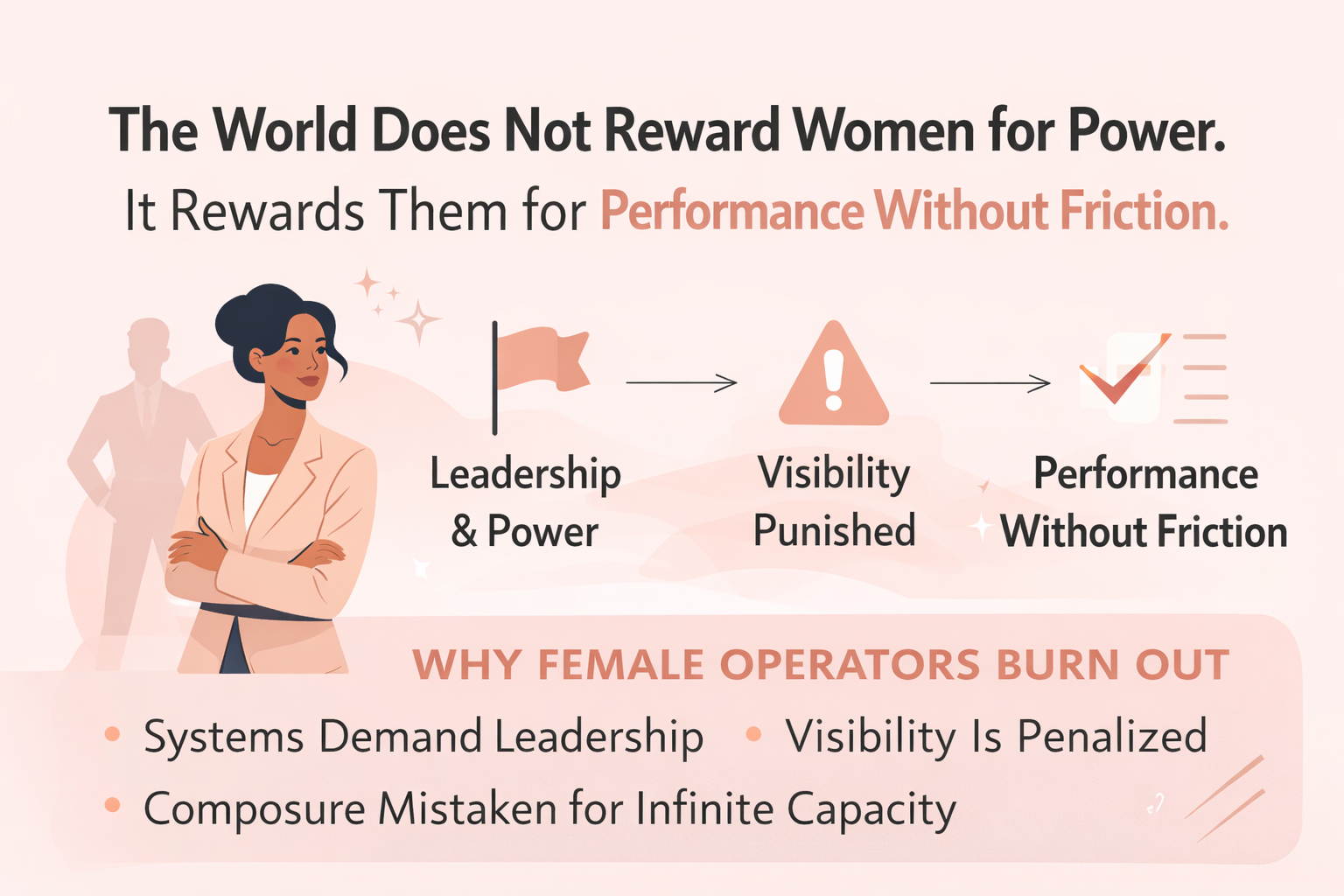
The World Does Not Reward Women for Power. It Rewards Them for Performance Without Friction.
.Why female operators burn out in systems that demand leadership, punish visibility, and mistake composure for infinite capacity.
There is a particular kind of woman modern systems depend on.
She is calm when things go sideways.
Prepared when others are vague.
Capable without being dramatic about it.
Emotionally regulated enough to absorb pressure without making everyone else uncomfortable.
Strong enough to lead, but socially aware enough not to appear threatening while doing it.
She is expected to carry complexity, stabilize dysfunction, and keep moving.
And then, almost as an added insult, she is often praised not for her authority, but for how little friction she creates while exercising it.
That is one of the quiet lies at the center of modern leadership culture for women.
Women are told to speak up, lead boldly, take initiative, build confidence, set standards, and own the room. But in practice, many systems do not reward female power in a clean or honest way. They reward female usefulness. More specifically, they reward high performance delivered in a form that does not unsettle the structure around it.
Not power.
Not sovereignty.
Not even leadership, in the full sense of the word.
Performance without friction.
That distinction matters.
Because once you see it, a lot of things start making sense.
Why so many highly capable women end up exhausted.
Why composure becomes mistaken for endless capacity.
Why the woman holding everything together is rarely the one being structurally protected.
Why “leadership development” advice often feels detached from reality.
Why women who are direct, clear, and unwilling to over-accommodate are still treated differently than men with the same traits.
The issue is not a lack of talent. It is not a lack of ambition. It is not a lack of confidence.
The issue is that many women are trying to build real authority inside systems that still prefer them as stabilizers, interpreters, emotional shock absorbers, and elegant executors of chaos.
That is not leadership. That is load-bearing femininity dressed up as empowerment.
And too many women have been taught to survive inside that pattern for so long that they no longer recognize how expensive it is.
The Invisible Tax
Competent women often live under a tax that is hard to name if you have not felt it.
It is the tax of being expected to be excellent and approachable.
Decisive but warm.
Clear but never too sharp.
Strong but never difficult.
Reliable but never in visible need of support.
Disciplined but still easy to work with in environments that are not designed with them in mind.
That tax is not always written into policy. Most of the time it is not explicit at all.
It lives in the social layer.
In who gets described as “a natural leader” versus “a lot.”
In who gets grace for bluntness and who gets penalized for tone.
In who is allowed a hard edge and who must constantly soften theirs to remain acceptable.
In who is assumed to be ambitious in an admirable way and who is treated as if ambition itself needs explanation.
Women who operate at a high level learn to read these signals early. They learn how much force the environment will tolerate. They learn when to speak, when to hold, when to present certainty, when to phrase certainty as a question, when to carry the team, when to disappear their own labor, and when to absorb impact so the room stays stable.
That adaptability is real. It is a skill.
But adaptability becomes dangerous when the system starts feeding on it.
Once people know you can carry pressure well, they often stop asking whether you should have to.
Once you prove you can remain composed under strain, others begin treating your composure as a resource they are entitled to consume.
Once you become the person who can handle things, your ability stops being respected as strength and starts being exploited as infrastructure.
This is where many women break in ways that are difficult to explain from the outside.
Not because they are weak.
Because they have been strong in environments that confuse steadiness with availability.
Composure Is Not Consent
One of the most damaging assumptions placed on high-functioning women is this:
If she is handling it, it must be fine.
It is not fine.
Calm is not the same as unharmed.
Competence is not the same as supported.
Composure is not the same as consent.
A woman can be disciplined, measured, grounded, and highly effective while carrying an unsustainable amount of strain. She can be performing at a high level inside a pattern that is quietly burning through her nervous system, her attention, her time, and her trust in the people around her.
And because she does not collapse theatrically, the system assumes no correction is required.
This is one of the reasons shallow empowerment language often fails women.
It tells them to become more visible, more assertive, more resilient, more confident, more boundaried. Some of that advice is useful. But much of it still puts the burden on the woman to optimize her response to an environment that remains structurally incoherent.
It asks her to become even more skillful in absorbing contradictions.
Be warm, but authoritative.
Be direct, but never abrasive.
Lead, but remain likable.
Set boundaries, but preserve group comfort.
Take up space, but not in a way that forces others to confront what they are accustomed to.
That is not liberation. That is advanced adaptation.
And adaptation, however impressive, is not the same thing as freedom.
Female Operators Need a Different Conversation
The women I am writing for are not waiting to be told to believe in themselves.
They already carry responsibility.
They already know how to execute.
They already know what it means to keep going when conditions are imperfect.
They already understand pressure.
What they need is a more honest conversation.
A conversation about the systems they are operating inside.
A conversation about energy, not just optics.
A conversation about standards without self-erasure.
A conversation about authority that is not based on performance theater.
A conversation about emotional regulation that does not become emotional self-abandonment.
Because emotional regulation is powerful. It matters. It is one of the great forms of modern strength.
But like any strength, it can be misused.
It can be turned inward until a woman becomes so skilled at managing herself that she no longer notices what she is tolerating.
It can become a performance of poise for the benefit of people who do not share the load.
It can become a way of surviving systems that should have been challenged much earlier.
Regulation matters. Presence matters. Leadership matters.
But none of them should require self-betrayal.
What Real Leadership Requires
Real leadership is not endless accommodation.
It is not being the most functional person in a dysfunctional room.
It is not making everyone else comfortable while quietly carrying the cost.
It is not proving your worth through constant restraint, emotional labor, or polished overperformance.
Real leadership requires discernment.
It requires knowing the difference between:
- being calm and being suppressed
- being collaborative and being over-accommodating
- being disciplined and being chronically self-denying
- being strong and being used
It requires standards.
Not performative standards. Not aesthetic standards. Not “girlboss” branding repackaged for a smarter audience.
Real standards.
What do I tolerate?
What do I normalize?
What do I repeatedly make easier for others at my own expense?
Where am I being valued for my leadership, and where am I being valued for how efficiently I absorb disorder?
What have I mistaken for strength that is actually overfunctioning?
These are not comfortable questions. But they are clean ones.
And clean questions change people.
This Is the Theme
This publication is for women who want more than visibility.
It is for women who want clarity.
Self-command.
Depth.
Discernment.
A steadier mind under pressure.
A sharper relationship to power, leadership, accountability, and the systems shaping their lives.
Not performance.
Not noise.
Not recycled empowerment slogans that sound good and cost nothing.
The point is not to become harder for the sake of hardness.
The point is to become more coherent.
To lead without dissolving into management theater.
To regulate without disappearing.
To think clearly in environments built to blur perception.
To build standards that actually protect your energy, your attention, and your authority.
To stop confusing endurance with alignment.
There is a difference between being impressive and being well-positioned.
A difference between being capable and being properly supported.
A difference between being needed and being respected.
Many women have been trained to settle for the first category while quietly starving in the second.
That has to end somewhere.
It may as well end here.

Member discussion